
Benefits and Uses of AI in Business in Pakistan
AI helps Pakistani businesses cut costs, automate repetitive work, make faster decisions, and serve customers around the clock. Common uses include customer support chatbots, fraud detection, demand forecasting, marketing automation, and document processing. Adoption is rising quickly: 43% of OICCI member companies already use generative AI. The best results come from starting with one clear business problem, preparing clean data, and measuring outcomes. Pakistani businesses that adopt AI in a structured way can improve efficiency and competitiveness while avoiding costly pilots that never scale.
Key Takeaways
- AI adoption in Pakistan is moving from experiments to real business use, backed by a national policy and a planned $1 billion investment by 2030.
- The strongest benefits are lower operating costs, faster decisions, better customer service, and scalable marketing.
- Data systems, weak governance, and outdated business processes are the biggest barriers to large-scale adoption.
- Globally, most companies use AI, but only a minority see measurable profit impact. Strategy matters more than software.
- Start small: pick one high-impact use case, clean your data, train your team, and track results.
Table of Contents
Why AI Matters for Pakistani Businesses Right Now
Pakistan now has a policy framework for AI. In July 2025, the federal cabinet approved the National AI Policy 2025. It targets one million trained AI professionals by 2030 and creates an AI Innovation Fund and an AI Venture Fund to involve the private sector. In February 2026, the Prime Minister announced a $1 billion investment plan for AI development by 2030.
Business sentiment is following. The OICCI Wave 28 survey covers firms accounting for nearly 80% of national GDP. It found that 43% of members have started integrating generative AI, and 81% expect AI to take on major business functions soon.
We recommend reading these numbers with care. OICCI members are largely multinationals, so they likely adopt faster than the average local SME. Commentary after Indus AI Week 2026 described Pakistan as still in “adoption mode, not invention mode.” For most local businesses, the opportunity is to use proven AI tools well, not to build new models.
Key Benefits of AI in Business in Pakistan
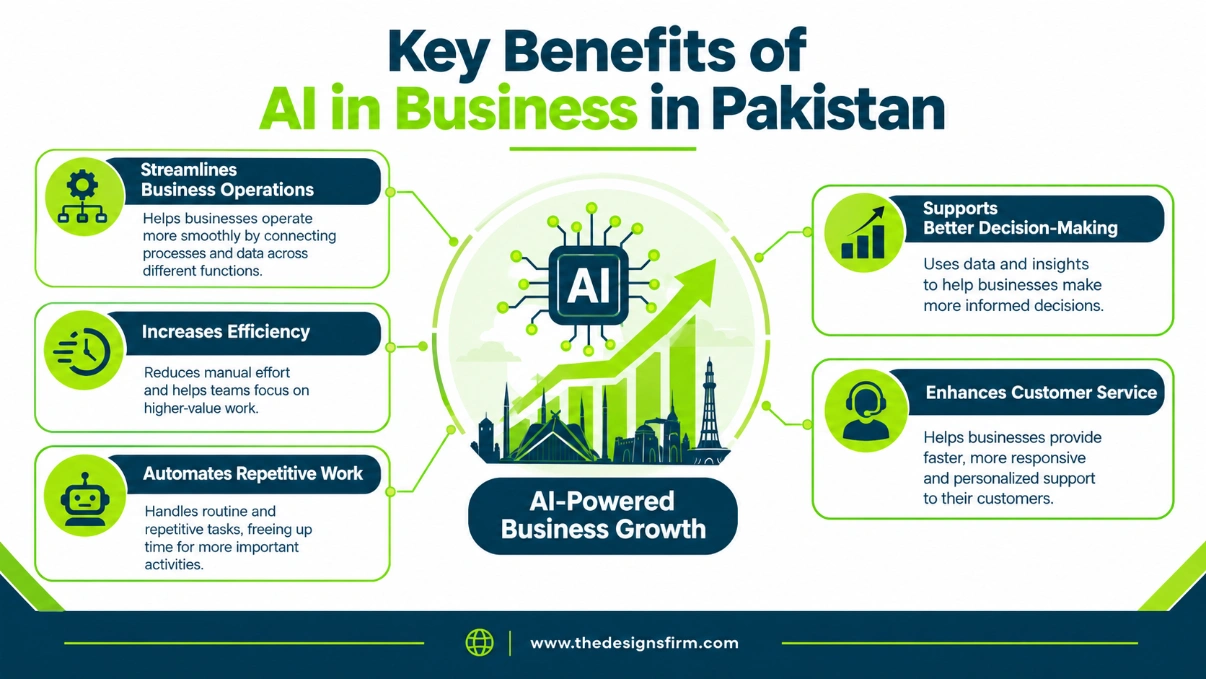
1. Lower Operating Costs
AI automates repetitive, rule-based work such as data entry, invoice processing, report generation, and first-line customer queries. Staff time moves to work that needs human judgment. This matters in a market where businesses cite inflation, taxation, and rupee volatility as ongoing risks.
2. Faster, Better Decisions
AI tools can analyze sales, inventory, and customer data in minutes instead of days. Better forecasting also reduces overstocking and stockouts, which protects cash flow.
3. Better Customer Experience
Chatbots and AI assistants answer common questions at any hour, in English or Urdu. Recommendation engines personalize offers. Globally, almost half of surveyed organizations report gains in customer satisfaction and competitive differentiation from AI.
4. Stronger Innovation
In the same McKinsey survey, 64% of respondents said AI has improved innovation at their organizations. Teams use AI to prototype faster, test messaging, and research markets at lower cost.
5. Scalable Growth Without Proportional Hiring
AI lets a small team handle more work. This is especially useful for Pakistani startups and SMEs that need to grow while staying lean.
Practical Uses of AI Across Pakistani Industries
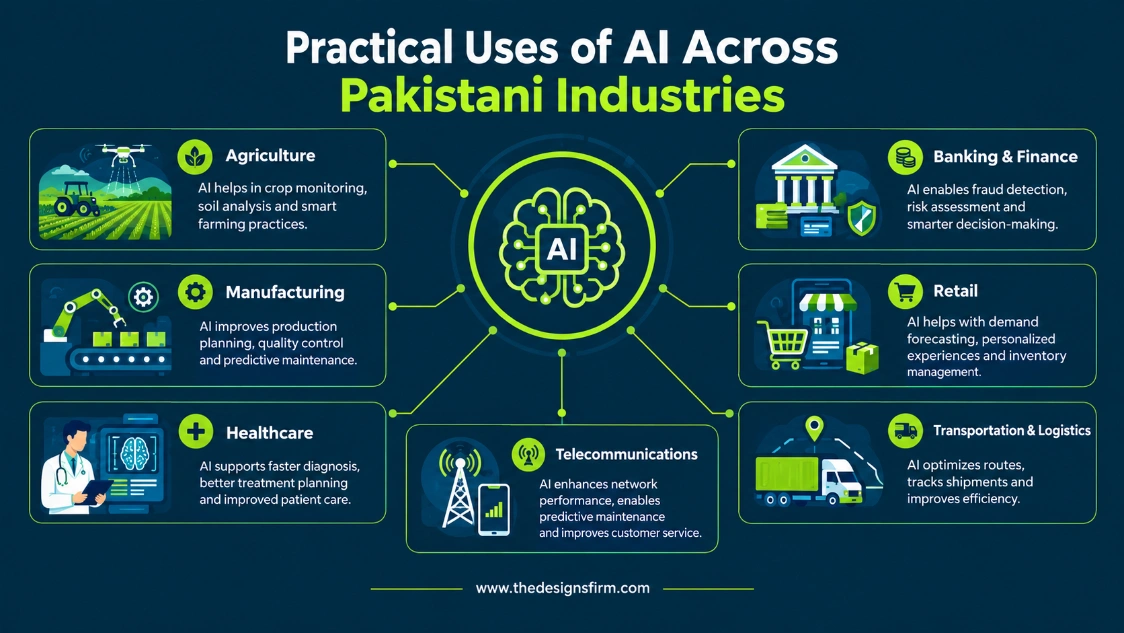
Banking and Fintech
Typical applications include fraud and anomaly detection, credit scoring support, customer service automation, and document verification. Fintech investment is also rising. VEON Group announced a $20 million investment in Mobilink Bank in early 2026.
Retail and E-Commerce
Retailers use AI for demand forecasting, dynamic pricing, product recommendations, and automated product descriptions. Sellers on marketplaces and social commerce channels use AI to handle customer messages at volume. If you are building an online store to put these tools to work, our e-commerce website development team can help you set up a store that is ready for them.
Manufacturing and Supply Chain
Factories use AI for predictive maintenance, quality inspection, and production planning. Predicting equipment failure before it happens reduces downtime and repair costs.
Marketing and SEO
At The Design Firm, we see marketing as the fastest place for most businesses to start. AI supports keyword research, content outlines, ad copy testing, email segmentation, and performance reporting. It works best with human oversight. AI speeds up the draft, and an expert keeps the content accurate, original, and on-brand.
Search itself is changing too, as people increasingly get answers from AI assistants instead of a list of links. If you want your business to show up in those answers, our AI search optimization services can help, and our guide to what answer engine optimization is explains the basics.
Finance and Operations
AI helps finance teams with reporting, reconciliation, and forecasting. Pakistani practitioners warn that layering AI on top of broken processes makes outputs faster, but not more reliable. Fix the process first.
Challenges Pakistani Businesses Must Plan For
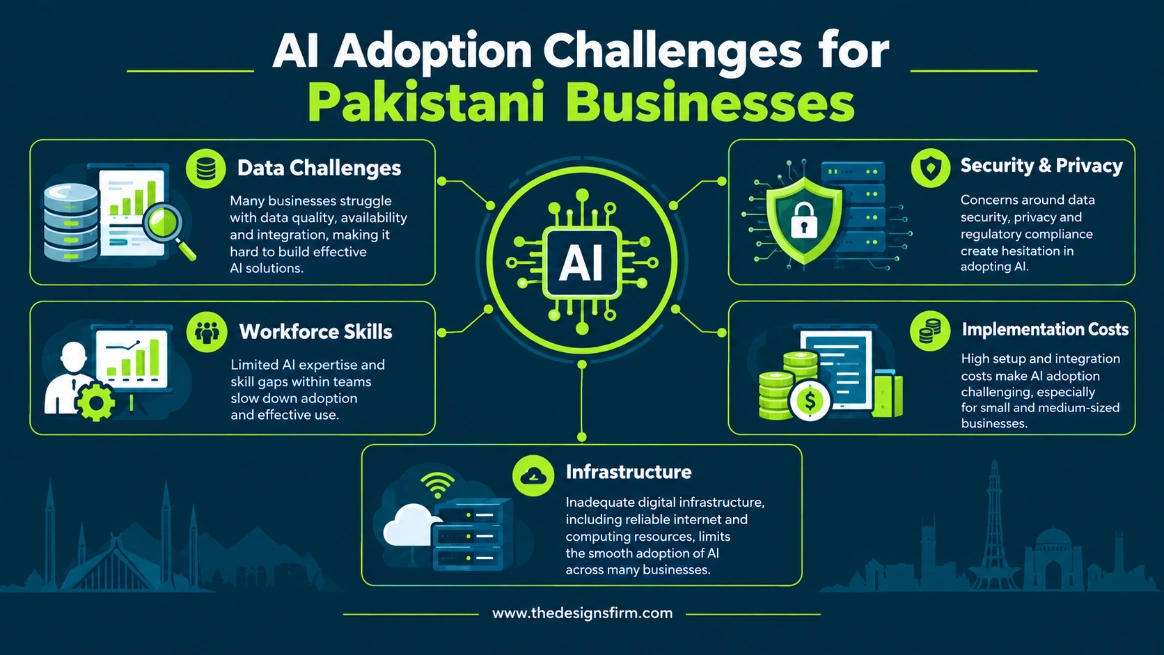
Weak Data Foundations
SAP’s regional leadership named data systems, inconsistent governance, and outdated business processes as the biggest barriers to large-scale AI adoption in Pakistan. Clean, structured data comes before any tool.
The Gap Between Using AI and Profiting From It
Globally, 88% of organizations use AI in at least one function, but only 7% say it is fully scaled. Only 39% report any enterprise-level profit impact, and most of those attribute less than 5% of EBIT to AI. We read this as a warning: buying tools is not a strategy.
Accuracy, Security, and Compliance Risks
AI can produce inaccurate outputs, and public tools can expose confidential data. Pakistan’s AI policy calls for stronger data protection and cybersecurity frameworks. Review AI outputs before publishing or acting on them, and never paste confidential client data into public AI tools.
Skills Gaps
The national target of one million trained AI professionals by 2030 shows how large the skills gap is. Most businesses will need to train existing staff, not just hire.
How to Start Using AI in Your Pakistani Business
- Pick one problem. Choose a task that is repetitive, measurable, and costly, such as support replies, lead qualification, or invoice processing.
- Check your data. Clean, structured data is a common bottleneck. Organize it before choosing a tool.
- Fix the process first. Document how the work happens today. Remove waste before automating it.
- Run a small pilot. Test with one team for 30 to 90 days. Set a baseline and a target before you start.
- Keep a human in the loop. Assign someone to review outputs, especially for customer-facing and financial work.
- Train your team. Short, practical training on prompts, limits, and data privacy prevents most early mistakes.
- Measure and scale. Track time saved, cost per task, conversion rate, or customer satisfaction. Expand only what shows results.
Conclusion
AI is no longer optional background technology for Pakistani businesses. It is becoming a competitive requirement, supported by national policy, rising investment, and growing adoption among large firms. The benefits are real: lower costs, faster decisions, better customer service, and scalable growth. But our experience matches the global data. Tools alone do not create results; clean data, clear goals, and trained people do.
Pick one use case this month, set a measurable target, and run a focused pilot. If you want help applying AI to your marketing, content, or website strategy, contact The Design Firm. We will help you build a plan that produces measurable results.