
How to Develop a Brand Strategy: A Step-by-Step Guide

A strong brand strategy gives your business a clear direction for how it should look, sound, communicate, and be experienced. It starts with your purpose, values, audience, and market position, then turns those foundations into consistent messaging and visual identity. At The Design Firm, we build brand strategies by combining business goals, audience research, competitor analysis, positioning, messaging, and design. The objective is not simply to create attractive branding; it is to create a consistent, recognizable brand that earns trust and supports long-term business growth.
Key Takeaways
- A brand strategy defines how your business should be positioned, communicated, and experienced across customer touchpoints.
- Start with your purpose, vision, values, audience, and competitive position before developing visual branding.
- Use real customer research to build useful buyer personas instead of relying on assumptions or basic demographics.
- Create consistent messaging, voice, visual identity, and brand guidelines so every channel communicates the same brand.
- Measure brand performance and update your strategy as your audience, market, and business change.
Table of Contents
What is a Brand Strategy?
A brand strategy is a structured plan for defining and managing how your business is positioned and perceived in the market.
Your brand is more than your logo, company name, colors, or typography. It includes the expectations, associations, experiences, and perceptions people develop when they encounter your business. Nielsen similarly describes a brand in terms of how people see, experience, and perceive an organization.
A brand strategy turns that broad concept into a practical framework. It answers questions such as:
- Why does your business exist?
- What does your brand stand for?
- Who are you trying to reach?
- What problems do you solve?
- Why should customers choose you?
- How should your brand communicate?
- How should your brand look and feel?
- What should customers consistently experience when interacting with you?
Without these decisions, marketing activities can become disconnected. Your website may use one message, social media another, advertising another, and sales materials something completely different.
Our approach at The Design Firm is to establish the strategic foundation first and then use that foundation to guide messaging, design, marketing, and customer-facing experiences.
Brand Strategy vs. Brand Identity
Brand strategy and brand identity are closely connected, but they are not the same thing.
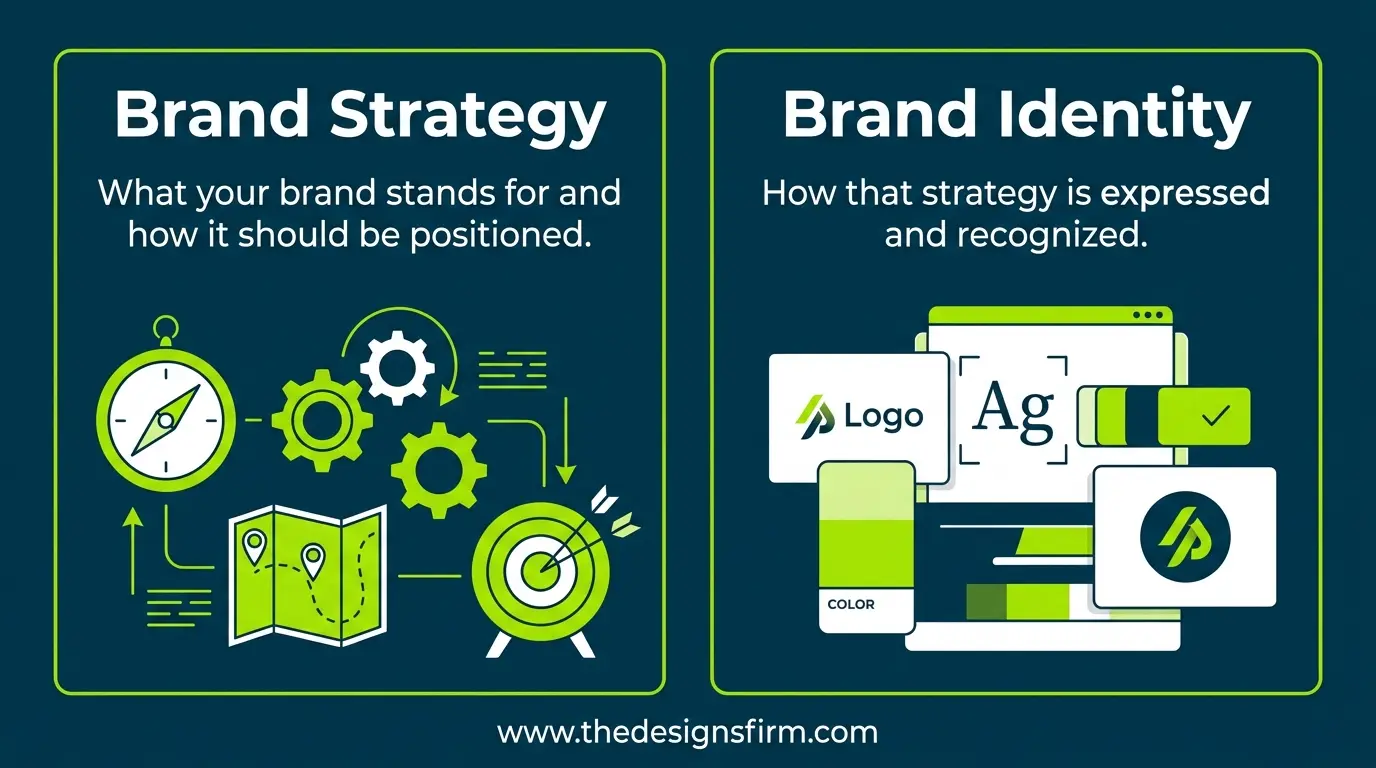
Brand strategy defines the direction behind the brand. It covers positioning, audience, purpose, values, messaging, personality, and competitive differentiation.
Brand identity is how that strategy becomes recognizable. It includes elements such as your logo, colors, typography, imagery, website, social media design, and other brand assets. Adobe describes brand identity as including both visual elements and intangible elements such as values, mission, personality, and tone of voice.
In simple terms:
Brand strategy = what your brand stands for and how it should be positioned.
Brand identity = how that strategy is expressed and recognized.
A professional brand needs both.
10 Steps to Develop a Brand Strategy
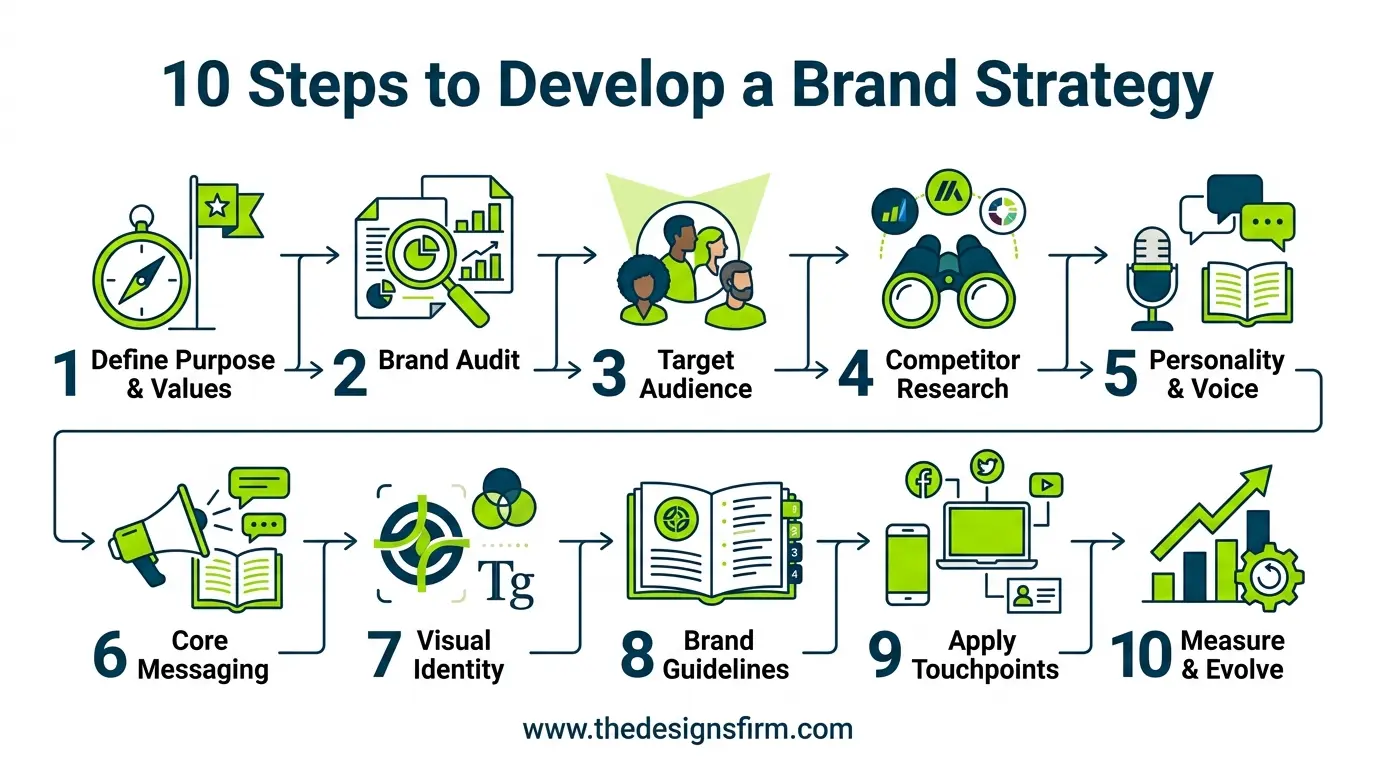
Step 1: Define Your Brand Purpose, Vision, and Values
Before deciding how your brand should look or sound, establish what your business stands for.
Define Your Purpose
Your purpose explains why your business exists beyond generating revenue.
Ask:
- What problem does our business solve?
- Why did we start?
- Who do we help?
- What change do we want to create?
- Why should our business exist instead of simply providing another product or service?
Your purpose should influence your decisions rather than exist only as a sentence on an About page.
A clear purpose can also help align your internal operations with your external brand. Nielsen recommends establishing clarity around company purpose and values and ensuring the brand’s external presentation reflects its internal direction.
Define Your Vision
Your vision describes where you want the business to go.
It should provide a clear long-term direction for your team and help you evaluate major decisions. A good vision is ambitious enough to guide growth but specific enough to influence strategic priorities.
Establish Your Core Values
Your values define the principles that guide how your company operates.
For example, your values might include:
- Innovation
- Transparency
- Customer focus
- Reliability
- Quality
- Accountability
- Sustainability
Do not choose values simply because they sound impressive. Choose principles your company is prepared to demonstrate through its decisions, products, services, and customer interactions.
Step 2: Conduct a Brand Audit
Before developing a new strategy, understand the brand you already have.
A brand audit examines your existing positioning, messaging, visual identity, customer experience, and market presence.
At The Design Firm, we would typically examine:
- Website copy and design
- Logo and visual identity
- Social media profiles
- Advertising
- Content marketing
- Sales materials
- Customer reviews
- Existing brand messaging
- Competitor positioning
- Search visibility
- Customer feedback
- Consistency between online and offline experiences
Look for gaps between what you want the brand to communicate and what customers actually encounter.
For example, a company may position itself as premium but use inconsistent visuals, weak website copy, and generic social media content. The problem is not necessarily the product; the problem is the disconnect between the intended positioning and the customer experience.
Your audit should identify what needs to be retained, improved, removed, or repositioned.
Step 3: Identify and Understand Your Target Audience
A brand cannot effectively communicate with everyone.
If you are unsure how to find your target audience, focus on understanding the specific people or organizations you want to attract, including their needs, motivations, concerns, expectations, and buying behavior.
Build Research-Based Buyer Personas
A buyer persona should be based on actual customer information rather than assumptions. HubSpot recommends using sources such as customer research, interviews, surveys, and data to identify recurring goals, challenges, objections, and behaviors.
Depending on your business, your research can include:
- Customer interviews
- CRM data
- Sales team feedback
- Customer reviews
- Support conversations
- Website analytics
- Search behavior
- Social media discussions
- Surveys
- Competitor research
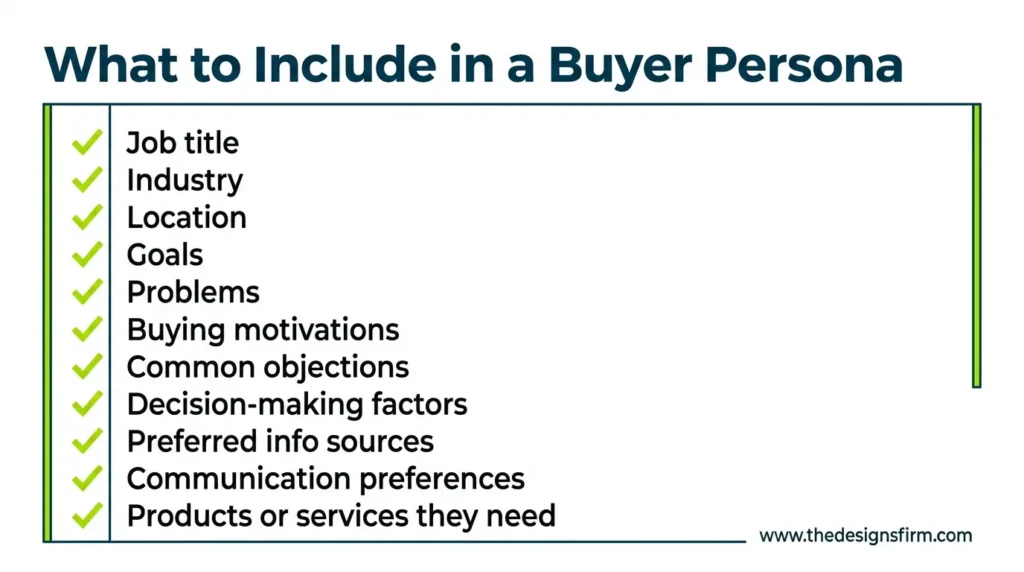
Your personas should document information such as:
- Job title or customer type
- Industry
- Location
- Goals
- Problems
- Buying motivations
- Common objections
- Decision-making factors
- Preferred information sources
- Communication preferences
- Products or services they need
For B2B brands, go beyond describing the individual buyer. Identify the organization, decision-making process, stakeholders, business requirements, and commercial priorities involved in the purchase.
The goal is to understand not just who your customer is, but why they buy.
Step 4: Research Your Competitors
Your brand is evaluated within a competitive environment. Understanding what competitors communicate helps you identify opportunities to differentiate.
Analyze competitors across areas such as:
Positioning
What do they claim to be known for?
Messaging
What benefits and problems do they emphasize?
Visual Identity
How do their websites, logos, colors, imagery, and marketing materials look?
Content
What topics do they publish? What questions do they answer? Where are content gaps?
Customer Experience
How do they communicate with prospects before, during, and after a purchase?
Strengths and Gaps
What appear to be their strongest differentiators? Where are customers underserved?
The objective is not to copy competitors.
Your objective is to identify a position that is meaningful to your target audience and defensible within your market.
A useful positioning opportunity might involve specialization, expertise, service quality, product innovation, customer experience, geographic focus, or a specific problem that competitors are not addressing effectively.
Step 5: Define Your Brand Personality, Voice, and Tone
Once your purpose, audience, and positioning are established, define how your brand should communicate.
Brand Personality
Brand personality describes the human characteristics associated with your brand.
Your brand might be:
- Professional
- Friendly
- Innovative
- Confident
- Practical
- Sophisticated
- Approachable
- Technical
Choose characteristics that fit both your business and your audience.
Brand Voice
Your brand voice is the consistent personality behind your communication.
For example, a B2B technology company may use a knowledgeable, direct, and professional voice, while a lifestyle brand may use a more conversational voice.
Adobe recommends maintaining a consistent brand voice across customer touchpoints while adapting tone according to context.
Brand Tone
Tone changes according to the situation.
Your core voice may remain consistent, but your tone can change between:
- A sales page
- A technical guide
- A social media post
- A customer complaint
- A product announcement
- A crisis communication
Document these differences so your team knows how to communicate consistently without making every piece of content sound identical.
Step 6: Develop Your Core Messaging and Value Proposition
Your brand strategy needs to become clear, usable language.
Create Your Value Proposition
Your value proposition should quickly communicate:
- Who you help
- What you help them achieve
- How you provide that value
- Why your solution is different
Avoid vague statements such as “We deliver innovative solutions” unless you explain what those solutions actually accomplish for customers.
A stronger value proposition connects your capability to a specific customer need.
Develop Your Key Messages
Your key messages should support your positioning across different channels.
They can cover:
- Primary customer benefit
- Main differentiator
- Product or service advantages
- Expertise
- Customer experience
- Proof points
- Brand promise
These messages become the foundation for website copy, advertising, social media, sales presentations, email campaigns, and other communications.
Create an Elevator Pitch
Your elevator pitch is a concise explanation of what your business does, who it serves, and the value it provides.
It should be easy for employees, sales representatives, partners, and customers to understand and repeat.
Develop Your Brand Story
A brand story explains the journey behind your business and connects your purpose, problem, solution, and future direction.
It should not become a long corporate history. Focus on the parts of your story that help customers understand why the company exists and what it stands for.
Step 7: Develop Your Visual Identity
Once the strategic foundation is clear, translate it into a visual system.
Your visual identity should reinforce your positioning rather than exist independently from it.
Logo
When investing in custom logo design services, ensure the final mark is distinctive, recognizable, functional, and scalable across different applications.
It should work across:
- Websites
- Social media
- Documents
- Presentations
- Packaging
- Signage
- Advertising
- Mobile devices
Color Palette
Colors contribute to brand recognition and communicate visual associations, making it crucial to learn how to choose the right color palettes for your industry.
Select a primary palette and supporting colors that reflect your brand personality and work consistently across digital and physical applications.
Define exact specifications such as HEX, RGB, CMYK, and other relevant formats where required.
Typography
Typography affects readability and personality.
Select font families and establish rules for:
- Headings
- Body copy
- Subheadings
- Captions
- Buttons
- Digital interfaces
- Printed materials
Photography, Graphics, and Imagery
Do not stop at logos and colors.
Using some of the best visual content creation tools can help you define the visual direction for photography, illustrations, icons, graphics, and other imagery so your content maintains a recognizable appearance across channels. Adobe notes that a cohesive brand identity should communicate a consistent personality across websites, social media, advertising, customer service, and other interactions.
Step 8: Create Brand Guidelines
Your brand strategy needs to be usable by everyone who creates or represents your brand.
That is why we recommend turning your decisions into documented brand guidelines.
Your guidelines can include:
- Brand purpose
- Mission
- Vision
- Core values
- Positioning
- Target audience
- Brand personality
- Voice and tone
- Key messages
- Value proposition
- Logo usage
- Logo variations
- Clear-space requirements
- Minimum logo size
- Incorrect logo usage
- Color specifications
- Typography
- Imagery style
- Graphic elements
- Social media guidelines
- Content guidelines
The purpose is not to create a document that sits unused.
Your guidelines should make it easier for employees, designers, writers, developers, agencies, and other partners to produce consistent brand communications.
Research from Lucidpress reported that consistent branding could increase revenue by up to 33%, based on a survey of more than 200 organizations. Because this was a survey-based finding rather than a controlled causal study, we treat it as an indication of the business value of consistency rather than a guaranteed revenue outcome.
Step 9: Apply the Brand Strategy Across Every Touchpoint
A brand strategy only becomes valuable when customers experience it consistently.
Website
Whether managed internally or built by a professional web design and development company, your website should communicate your positioning within seconds.
Review:
- Homepage messaging
- Navigation
- Visual identity
- Service or product pages
- Calls to action
- About page
- Content
- User experience
- Conversion paths
The website should look, sound, and behave like the same brand customers encounter elsewhere.
Social Media
Social media should use the same visual identity, personality, and messaging principles.
Consistency should cover:
- Profile imagery
- Post designs
- Captions
- Content topics
- Writing style
- Responses to comments
- Video content
- Promotional campaigns
Consistency does not mean posting the exact same content everywhere, as each of the major social media platforms can have its own format while remaining recognizably part of the same brand.
Advertising
If you are running PPC campaigns or partnering with a Google Ads agency, these paid efforts should reinforce your positioning rather than introduce a completely different identity.
Align your:
- Ad copy
- Creative
- Offers
- Landing pages
- Calls to action
- Visual elements
This creates a more coherent path from advertisement to conversion.
Sales and Customer Service
Your sales and customer service teams are part of the brand.
If your positioning promises expert guidance, your sales process should demonstrate expertise.
If your brand promises responsiveness, customer service should reflect that promise.
The customer experience must support what your marketing claims.
Step 10: Measure, Monitor, and Evolve Your Brand Strategy
A brand strategy should not remain unchanged forever.
Markets shift. Competitors change. Customer expectations evolve. Businesses introduce new products and enter new markets.
Monitor whether your brand is achieving the outcomes you intended.
Brand Metrics to Track
Depending on your objectives, useful metrics can include:
- Brand awareness
- Branded search volume
- Direct traffic
- Brand mentions
- Share of voice
- Social engagement
- Customer sentiment
- Website engagement
- Conversion rate
- Customer retention
- Repeat purchases
- Customer reviews
- Lead quality
- Purchase intent
Do not track every metric simply because it is available.
Choose measurements that connect directly to your brand objectives.
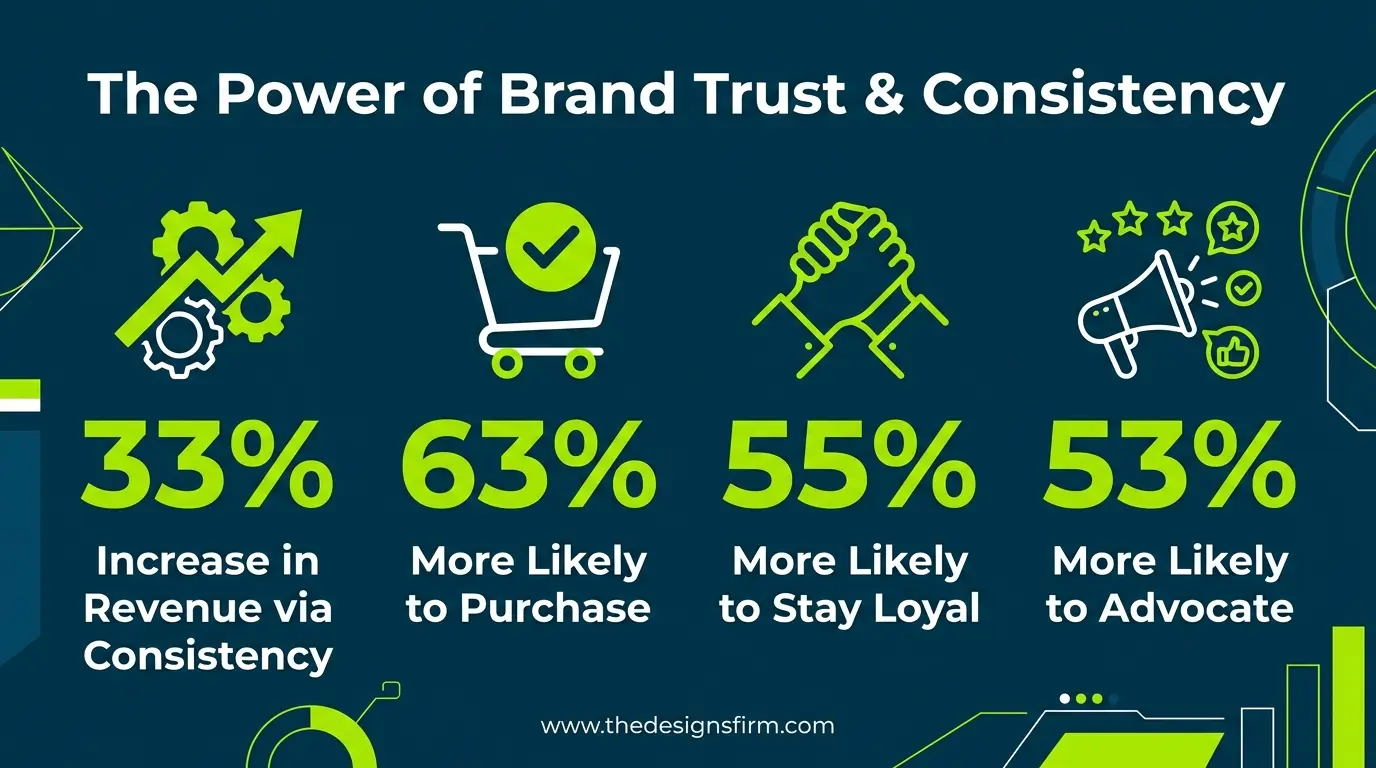
Trust is also an important part of brand performance. In Edelman’s 2024 global research across 14 markets, respondents who fully trusted a brand were 63% more likely to report purchasing from it, 55% more likely to stay loyal, and 53% more likely to advocate for it compared with those who did not fully trust the brand.
These figures reinforce why brand strategy should extend beyond visual recognition. The objective is to build a brand experience that customers can understand, recognize, and trust.
How We Develop Brand Strategies at The Design Firm
At The Design Firm, a leading branding agency in Karachi, we approach branding as a strategic business process rather than a simple logo-design exercise.
Our work can involve:
- Business discovery — We understand your business model, objectives, products, services, and growth plans.
- Brand audit — We evaluate your current positioning, identity, messaging, and customer-facing touchpoints.
- Audience research — We identify the audiences you need to reach and the problems, motivations, and expectations that influence them.
- Competitor analysis — We study the competitive landscape to identify positioning opportunities and market gaps.
- Brand positioning — We establish how your business should be differentiated and understood.
- Messaging strategy — We develop your value proposition, key messages, brand story, and communication direction.
- Brand personality and voice — We define how your brand should communicate across different channels.
- Visual identity — We translate the strategy into a cohesive visual system.
- Brand guidelines — We document the rules needed to maintain consistency.
- Implementation — We help apply the strategy across websites, social media, marketing materials, advertising, and other customer touchpoints.
- Measurement and refinement — We monitor performance and adjust the strategy as your business and market evolve.
This approach connects strategy with execution. Instead of developing a brand that only looks good, we build a framework your marketing and business teams can actually use.
Common Brand Strategy Mistakes to Avoid
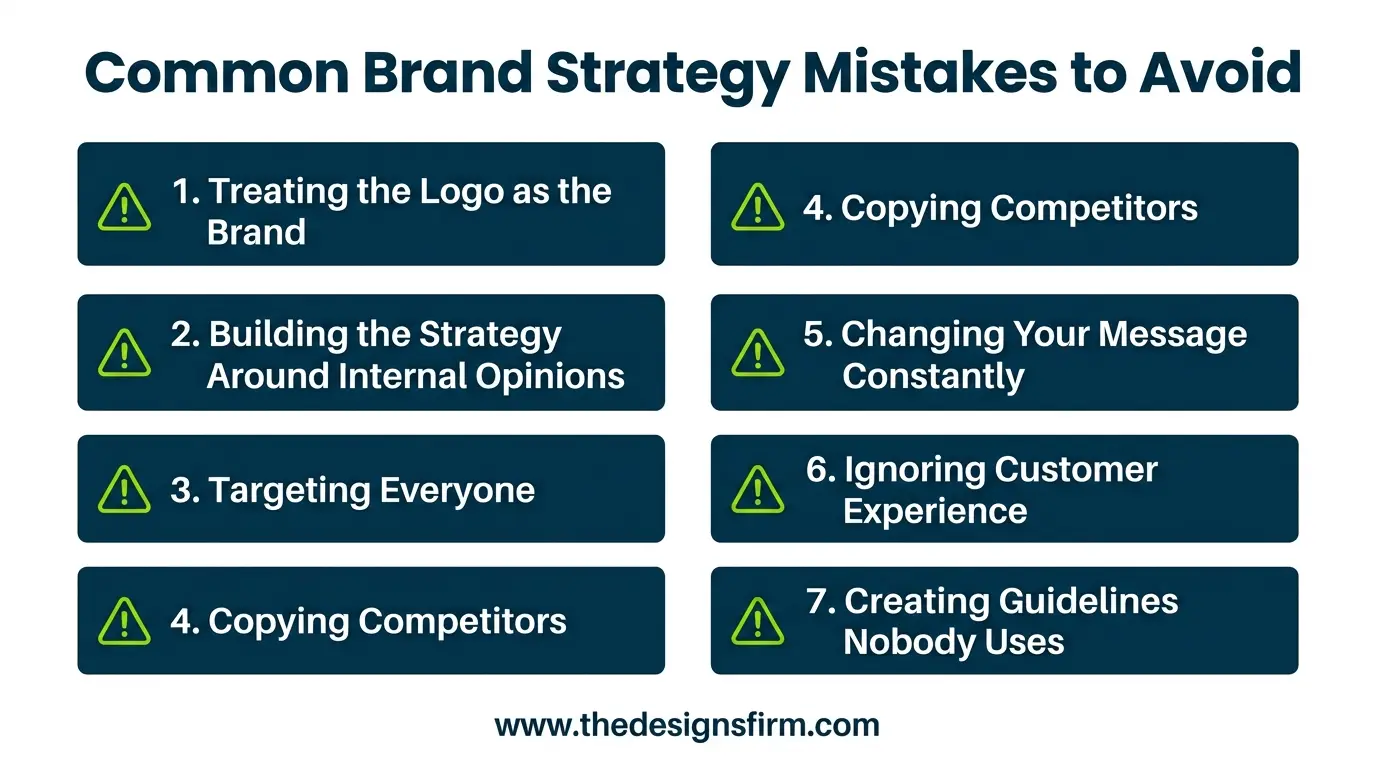
Treating the Logo as the Brand
A logo is an important identity asset, but it cannot define your positioning, customer experience, messaging, or reputation by itself.
Building the Strategy Around Internal Opinions
Your leadership team’s preferences matter, but your strategy should also consider customer research, market conditions, and competitive positioning.
Targeting Everyone
Trying to appeal to everyone usually makes positioning less specific. Define the audiences that matter most to your business.
Copying Competitors
Competitor research should reveal opportunities, not provide a template to imitate.
Changing Your Message Constantly
Brands need room to evolve, but constantly changing positioning makes it harder for customers to understand what the business stands for.
Ignoring Customer Experience
A strong advertising campaign cannot compensate indefinitely for a poor product or inconsistent customer experience.
Creating Guidelines Nobody Uses
Brand guidelines only work when employees and external partners can understand and apply them in real situations.
Conclusion
A strong brand strategy gives your business a clear framework for positioning, communication, design, and customer experience. The process starts with your purpose and values, then moves through audience research, competitor analysis, positioning, messaging, visual identity, guidelines, implementation, and measurement.
At The Design Firm, we believe effective branding connects strategy with execution. Start by understanding what your business stands for, who you want to reach, what makes you different, and what experience you want customers to have. Then turn those decisions into consistent messages and experiences across every touchpoint.
A brand strategy should not be treated as a one-time design project. It should become a practical business framework that guides how your organization communicates, markets, and grows.