
What is Inbound Marketing: A Comprehensive Guide

Inbound marketing is a customer-centric strategy that attracts prospects through valuable content and helpful experiences instead of interruptive ads. Rather than pushing messages out, you earn attention with blog posts, SEO, social media, email, and video, then guide visitors from first visit to purchase and beyond. HubSpot’s methodology organizes this into three stages: attract, engage, and delight. When done well, inbound builds trust, generates qualified leads, and creates compounding growth that keeps working long after each piece of content is published.
Key Takeaways
- Inbound marketing earns attention with helpful content. Outbound marketing buys or forces attention.
- The methodology has three stages: attract, engage, and delight.
- Marketers rank website, blog, and SEO as their top ROI-generating channel.
- Search is changing. Google users clicked a traditional result in 8% of visits when an AI summary appeared, versus 15% without one.
- Quality wins. 65% of effective B2B marketers credit content relevance and quality for their results.
Table of Contents
What Is Inbound Marketing?
Inbound marketing is a methodology for attracting customers by answering the questions they already have. Your audience searches, reads, compares, and decides. Inbound puts your brand in front of them at each of those moments with content that helps.
HubSpot, which popularized the approach, describes it as aligning your marketing with your target audience’s needs, supported by content creation and SEO.
At The Design Firm, we describe it simply: be the best answer when your customer goes looking.
Inbound vs. Outbound Marketing
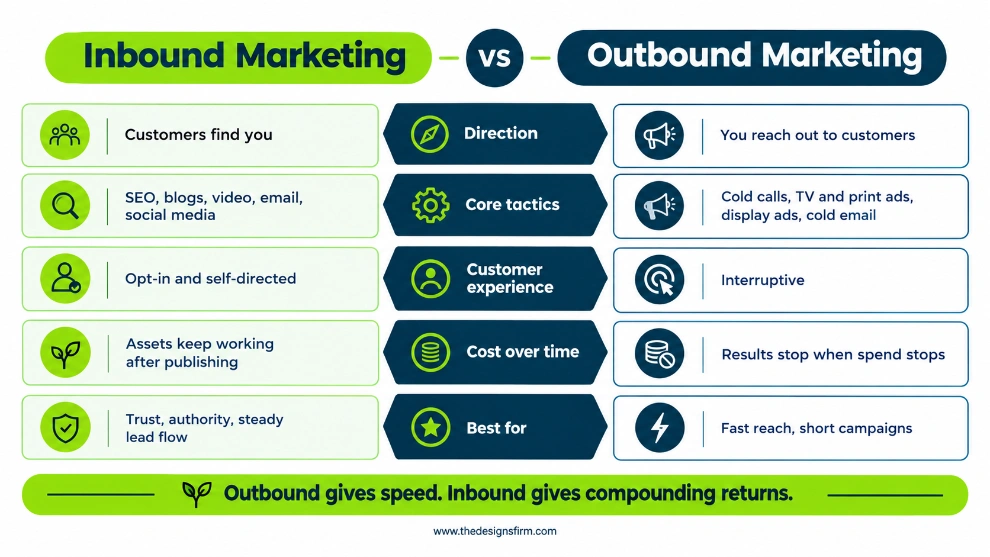
| Inbound Marketing | Outbound Marketing | |
|---|---|---|
| Direction | Customers find you | You reach out to customers |
| Core tactics | SEO, blogs, video, email, social media | Cold calls, TV and print ads, display ads, cold email |
| Customer experience | Opt-in and self-directed | Interruptive |
| Cost over time | Assets keep working after publishing | Results stop when spend stops |
| Best for | Trust, authority, steady lead flow | Fast reach, short campaigns |
Neither approach is always right. Outbound gives speed. Inbound gives compounding returns. Most strong marketing programs use both, with inbound as the foundation.
The Three Stages of the Inbound Methodology
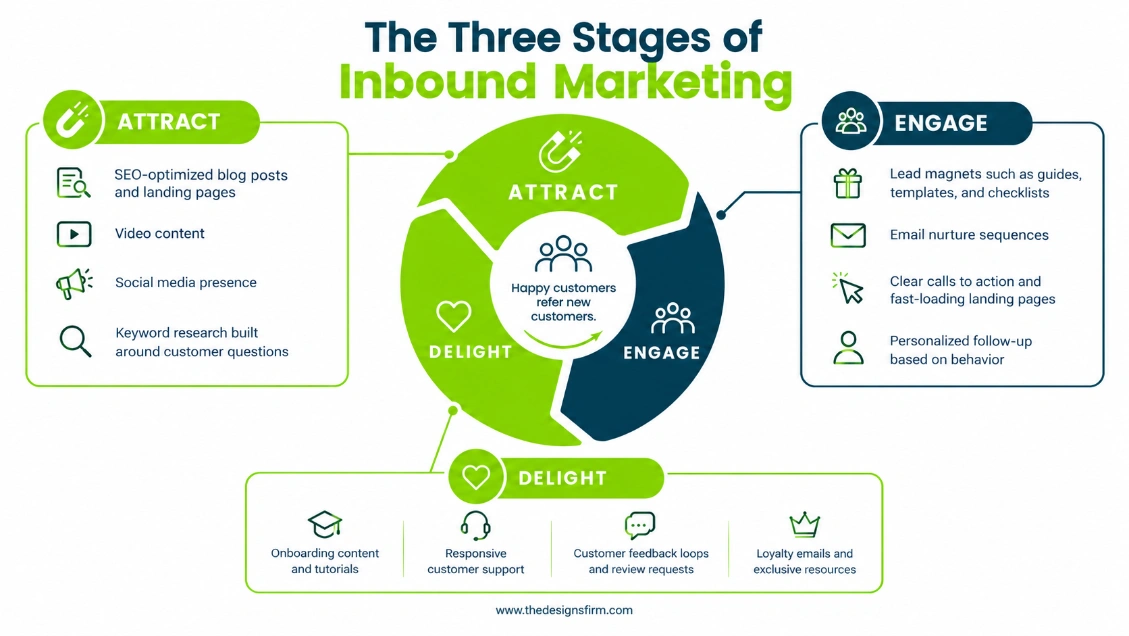
Attract
The goal is to bring the right people to your brand, not just any traffic. This means understanding your ideal customer and publishing content that matches their search intent. Core attract tactics include:
- SEO-optimized blog posts and landing pages
- Video content
- Social media presence
- Keyword research built around customer questions
Engage
Once visitors arrive, the goal is to build a relationship. HubSpot’s approach is to present insights and solutions that fit a prospect’s needs, and to use email and marketing automation to deliver the right information at the right time. Core engage tactics include:
- Lead magnets such as guides, templates, and checklists
- Email nurture sequences
- Clear calls to action and fast-loading landing pages
- Personalized follow-up based on behavior
Delight
Inbound does not end at the sale. Delight means supporting customers so they succeed, stay, and refer others. Core delight tactics include:
- Onboarding content and tutorials
- Responsive customer support
- Customer feedback loops and review requests
- Loyalty emails and exclusive resources
This is why the model is often drawn as a flywheel. Happy customers add momentum by referring new ones.
Core Inbound Marketing Channels
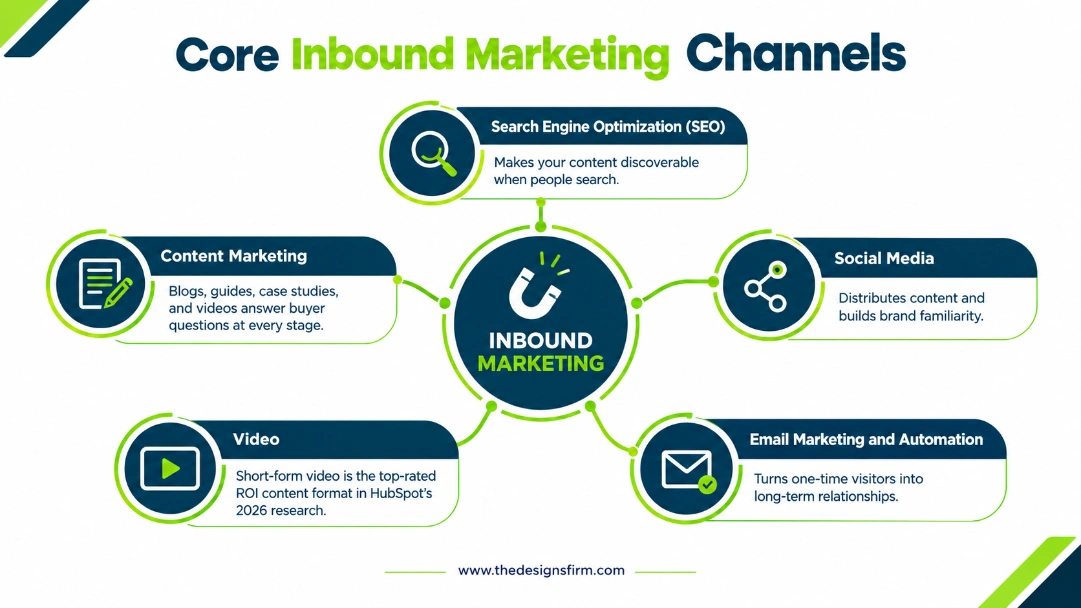
Search Engine Optimization (SEO)
SEO makes your content discoverable when people search. Technical health, relevant content, and strong structured data all contribute. It is also the channel marketers trust most: in HubSpot’s 2026 survey, website, blog, and SEO ranked first for ROI at 27%. If you want expert help building that foundation, our SEO services in Pakistan cover technical health, content, and structured data in one program.
Content Marketing
Blogs, guides, case studies, and videos answer buyer questions at every stage. Content is the fuel for every other inbound channel. Marketers are backing owned media too: 32% of B2B marketers plan to increase investment in content assets, website, blog, and email in 2026. If you are wondering whether publishing regularly is worth the effort, this breakdown of whether blogging helps SEO is a useful read.
Social Media
Social media distributes your content and builds brand familiarity. For B2B brands, LinkedIn stands out: 76% of B2B marketers name it among the most effective channels for sharing thought leadership. Brands that want to build that presence can work with a LinkedIn marketing agency to turn expertise into consistent reach.
Email Marketing and Automation
Email turns one-time visitors into long-term relationships. Among B2B marketers who personalize content, 85% do so in email campaigns. Segmented, behavior-based sequences move leads toward a decision without manual effort. If you are getting started, these free email marketing tools make it easy to test sequences before investing in a larger platform.
Video
Short-form video is the top-rated ROI content format in HubSpot’s 2026 research. Pair it with written content so your message works on search and social.
Benefits of Inbound Marketing
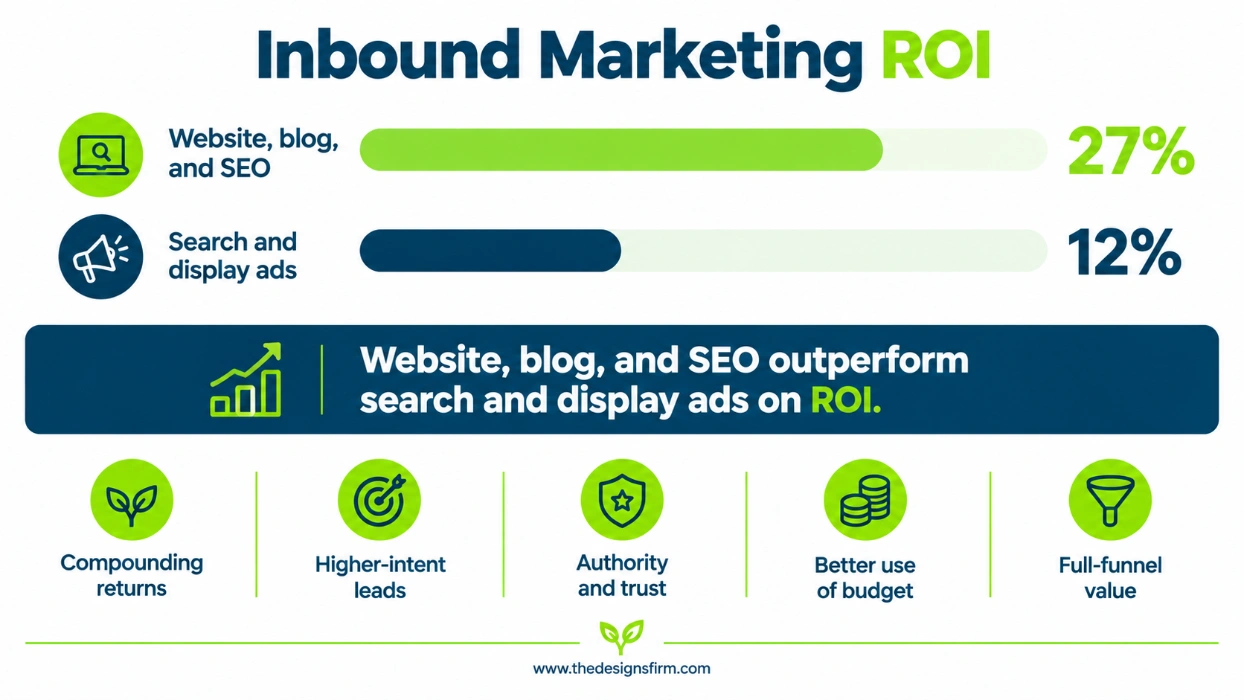
- Compounding returns. A well-ranked article can bring leads for years without ongoing ad spend.
- Higher-intent leads. People who find you while searching already have a need.
- Authority and trust. Consistent, helpful content positions your brand as an expert.
- Better use of budget. Website, blog, and SEO outperform search and display ads on ROI. 27% of marketers rank the former first, versus 12% for the latter.
- Full-funnel value. Inbound supports awareness, conversion, and retention in one system.
Inbound Marketing in the Age of AI Search
Search behavior is shifting, and inbound strategies must shift with it. Pew Research Center analyzed the browsing of 900 U.S. adults in March 2025. Users clicked a traditional result link in 8% of visits when a Google AI summary appeared, compared with 15% when it did not.
Marketers are responding. Updating SEO strategy for search changes is one of the top trends in 2026, cited by 40.6% of them. Content volume is rising too, with 83.5% of marketers saying they are expected to produce more content.
Faster production does not guarantee better results. Among B2B marketers using AI for content creation, 87% report improved productivity, but only 39% report improved content performance. 12% say content quality actually decreased. Differentiation is the real challenge. Our approach:
- Publish content with original insight, real data, and first-hand experience.
- Structure pages with clear headings, direct answers, and schema markup so both search engines and AI tools can understand them.
- Build topical authority around a focused set of subjects instead of scattered posts.
If you want your content to be cited in AI-generated answers, our team offers AEO and AI search optimization services built for exactly this shift.
How to Build an Inbound Marketing Strategy
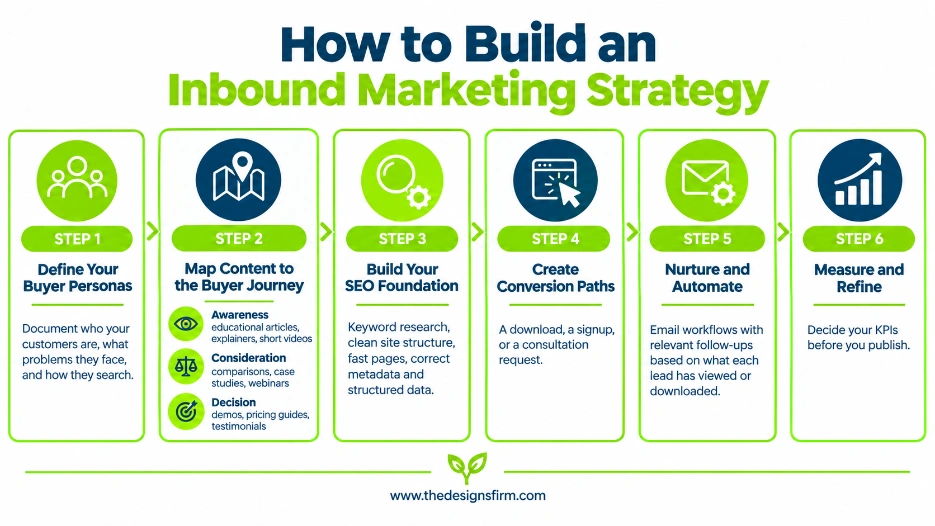
Step 1: Define Your Buyer Personas
Document who your customers are, what problems they face, and how they search. Use real sales and support conversations, not assumptions. If you need a starting point, this guide on how to find your target audience walks through the process.
Step 2: Map Content to the Buyer Journey
Create content for each stage:
- Awareness: educational articles, explainers, short videos
- Consideration: comparisons, case studies, webinars
- Decision: demos, pricing guides, testimonials
Step 3: Build Your SEO Foundation
Start with keyword research, a clean site structure, fast pages, and correct metadata and structured data. Content cannot perform on a site search engines struggle to crawl. Understanding Google ranking factors helps you prioritize which fixes matter most.
Step 4: Create Conversion Paths
Every important page needs a next step: a download, a signup, or a consultation request. This is where many teams struggle. 40% of B2B marketers name creating content that prompts a desired action as a top-three challenge. For a closer look at what turns visitors into leads, see our explainer on conversions and conversion rate.
Step 5: Nurture and Automate
Set up email workflows that send relevant follow-ups based on what each lead has viewed or downloaded. This overview of marketing automation explains how to build those workflows without adding manual work.
Step 6: Measure and Refine
Measurement is a common weak spot. 33% of marketers name measuring marketing ROI as their top challenge, and 33% of B2B marketers list measuring content effectiveness among their top three content challenges. Decide your KPIs before you publish. A practical guide to SEO tracking can help you set that up.
Metrics That Matter
- Organic traffic and keyword rankings
- Conversion rate on landing pages
- Marketing qualified leads (MQLs) and sales qualified leads (SQLs)
- Cost per lead and customer acquisition cost
- Lead-to-customer rate
- Customer retention and referral rate
Common Inbound Marketing Mistakes
- Publishing without a strategy. Among B2B marketers whose content strategy improved, 74% credit strategy refinement. Random content rarely performs.
- Chasing traffic over leads. Visits only matter if they convert.
- Ignoring existing content. Updating older posts is often faster than writing new ones.
- Skipping the delight stage. Retention and referrals are cheaper than new acquisition.
- Expecting instant results. Inbound builds over months. Plan for that timeline.
Conclusion
Inbound marketing works because it matches how people buy: they research first and decide later. Brands that provide clear, useful answers earn trust before a sales conversation begins.
Here is how we recommend getting started:
- Pick one buyer persona and list its top ten questions.
- Turn each question into a keyword-targeted page or video.
- Add a clear conversion path to every page.
- Set up one email nurture sequence.
- Review results monthly and update what underperforms.
At The Design Firm, we build inbound programs on technical SEO, structured content, and measurable goals. Start small, stay consistent, and let the results compound.