
Best YouTube SEO Tools to Grow Your Channel in 2026
The best YouTube SEO tools in 2026 are built around what actually decides YouTube rankings: watch time, click-through rate, and engagement. The stack that works starts free with YouTube Studio and Google Trends, adds vidIQ and TubeBuddy for keyword research and A/B testing, layers in NexLev for competitor and outlier research, and uses ChatGPT, Gemini, and Claude for scripts, titles, and descriptions. General web-SEO suites like Ahrefs and SEMrush are built for Google search, so they aren’t part of this list. Used together rather than one at a time, these tools can meaningfully speed up channel growth, and titles rewritten around real search intent can lift click-through rate by roughly 30% on their own.
Key Takeaways
- YouTube is the world’s second-largest search engine, handling 3+ billion searches a month, and it ranks videos on watch time, click-through rate, and engagement.
- The practical toolkit has four layers: free research (YouTube Studio, Google Trends), optimization suites (vidIQ, TubeBuddy), competitor and outlier research (NexLev), and AI writing assistants (ChatGPT, Gemini, Claude).
- Titles rewritten around real search intent can lift click-through rate by roughly 30% on their own.
- 87% of creators already using AI tools say it has accelerated their channel or business growth, and 75% now call it essential to their workflow.
Table of Contents
YouTube SEO Tools: The Free Foundation Every Channel Should Start With
YouTube Studio
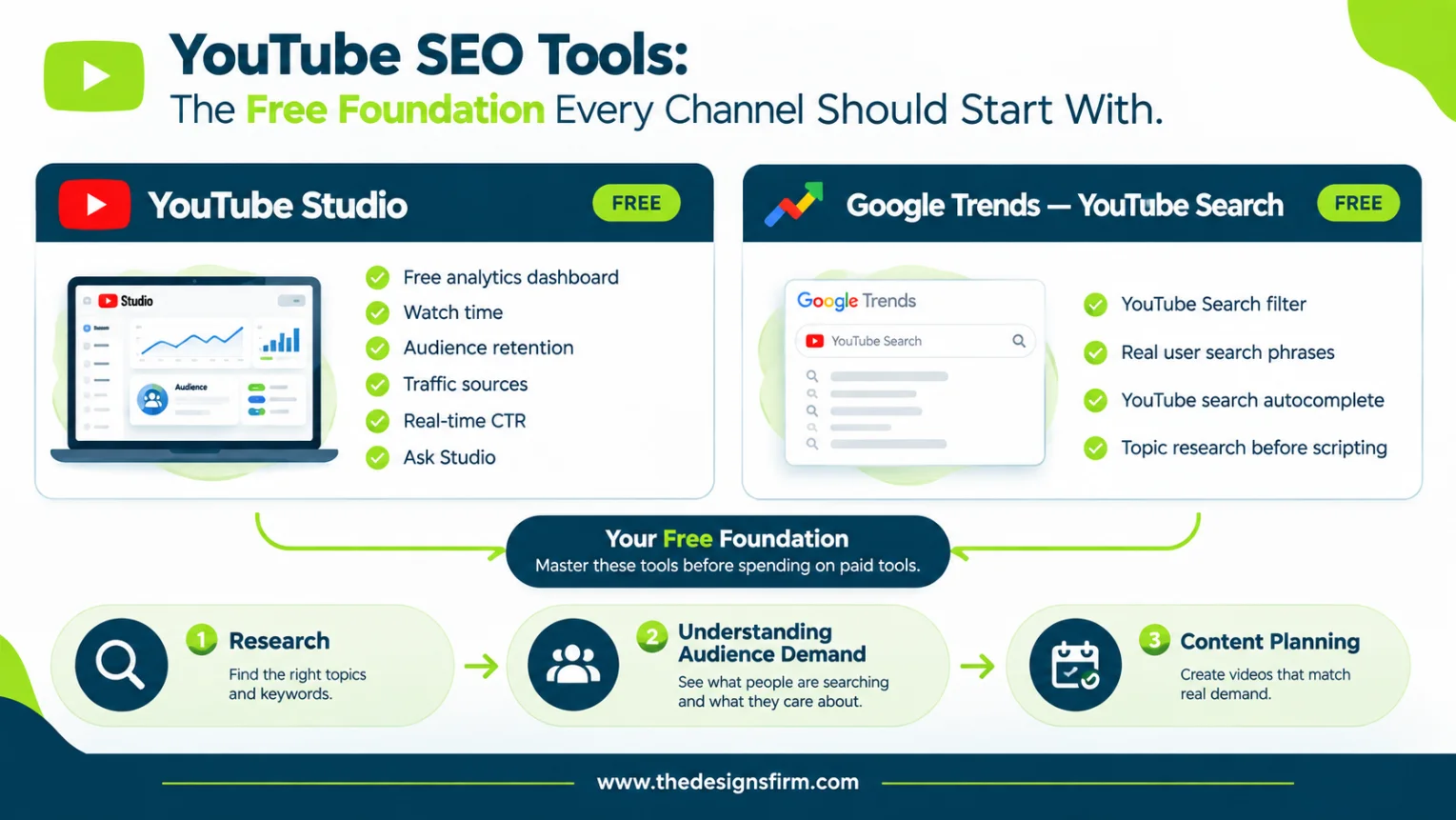
YouTube Studio is the free analytics dashboard built into every channel, and it’s the only tool with direct access to a channel’s exact watch time, audience retention curves, traffic sources, and real-time CTR. In 2026, YouTube added Ask Studio, a built-in AI feature that answers plain-language questions about a channel’s performance, summarizes comments and feedback, and helps brainstorm ideas and outlines for upcoming videos, all without leaving Studio.
Before spending on any paid tool, mastering Studio’s own analytics is the highest-leverage first step. It’s the same underlying data every other tool on this list is trying to approximate from the outside. Studio also shows when your viewers are most active, which pairs well with our guide to the best time to upload YouTube videos in Pakistan.
Google Trends (YouTube Search Filter)
Google Trends is free and often overlooked for YouTube specifically. Setting the search type to “YouTube Search” instead of the default web search shows what people are actually typing into YouTube’s own search bar, which is not the same as what they search on Google. Pair this with YouTube’s native search-bar autocomplete (typing a seed keyword directly into YouTube and noting the suggestions) and you get a fast, zero-cost read on real user phrasing before you script a single video.
Dedicated YouTube Optimization Platforms
vidIQ
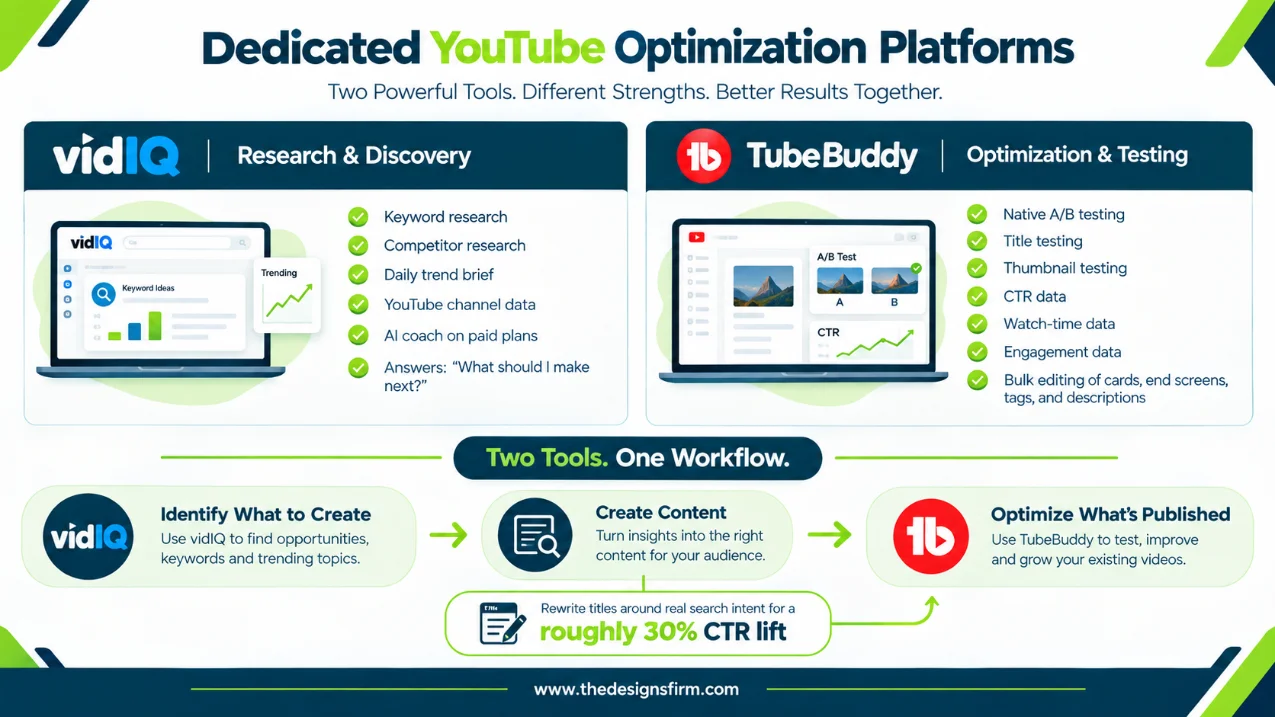
vidIQ is a research and discovery platform: an official YouTube-certified partner with direct API access to channel data. Its strength is answering “what should I make next”: keyword and competitor research, a daily trend brief for your niche, and, on paid plans, an AI coach that reads your own channel analytics and explains why a specific video underperformed.
TubeBuddy
TubeBuddy sits on the other side of the workflow: optimizing what’s already published. Its signature feature is native A/B testing, running controlled experiments on titles and thumbnails against real CTR, watch-time, and engagement data, then declaring a winner. It also bulk-edits cards, end screens, tags, and descriptions across an entire back catalog at once, which matters once a channel has more than a handful of videos to maintain.
Between the two: rewriting a title around real search intent can lift CTR by roughly 30% on its own. Running that title (or a thumbnail) through an A/B test in either tool is how you confirm which specific version earns that lift for your own audience, rather than guessing.
Competitor and Outlier Research: NexLev
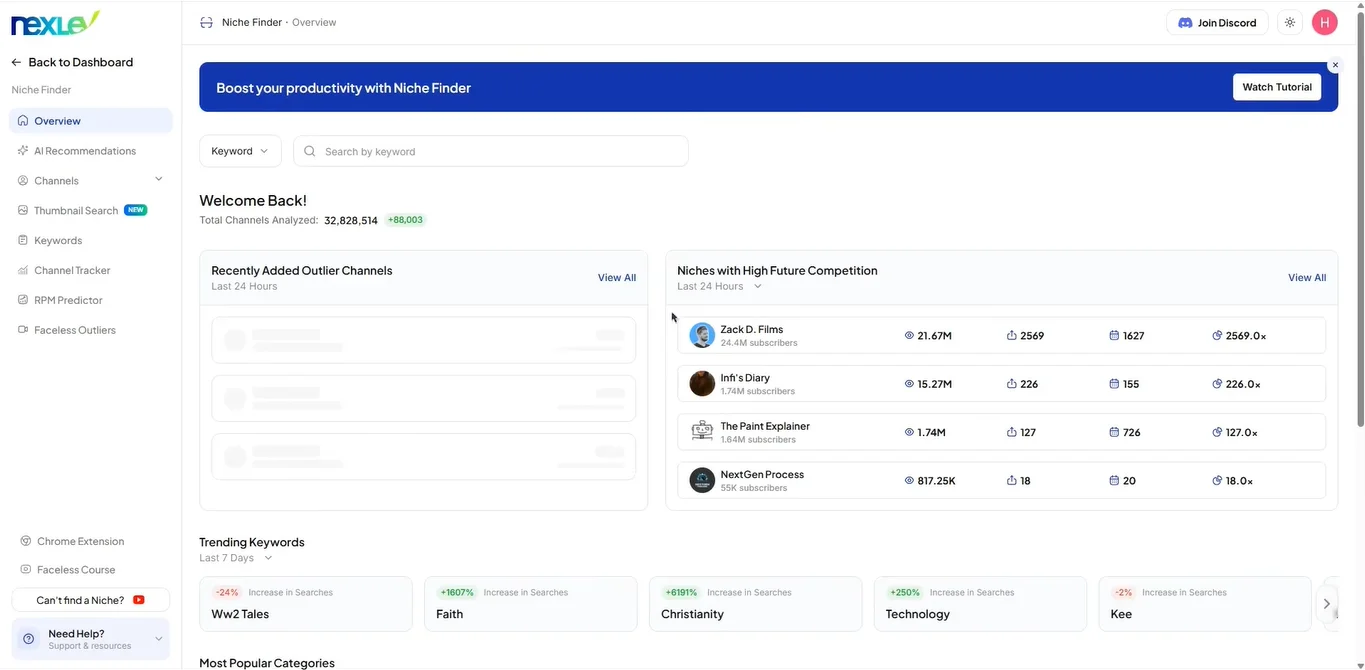
Where vidIQ and TubeBuddy mostly look inward at a channel’s own performance, NexLev looks outward. It’s built around niche and competitor research: surfacing outlier videos, tracking real-time and emerging competitor and faceless channels, and scoring niches by demand, competition, and estimated revenue, with a particular focus on faceless-channel content strategy.
For deciding what to make next based on what’s already proven to work across a niche, not just a channel’s own upload history, this is the layer vidIQ and TubeBuddy don’t fully cover on their own.
AI LLMs for Scripting, Titles, and Descriptions: ChatGPT, Gemini, and Claude
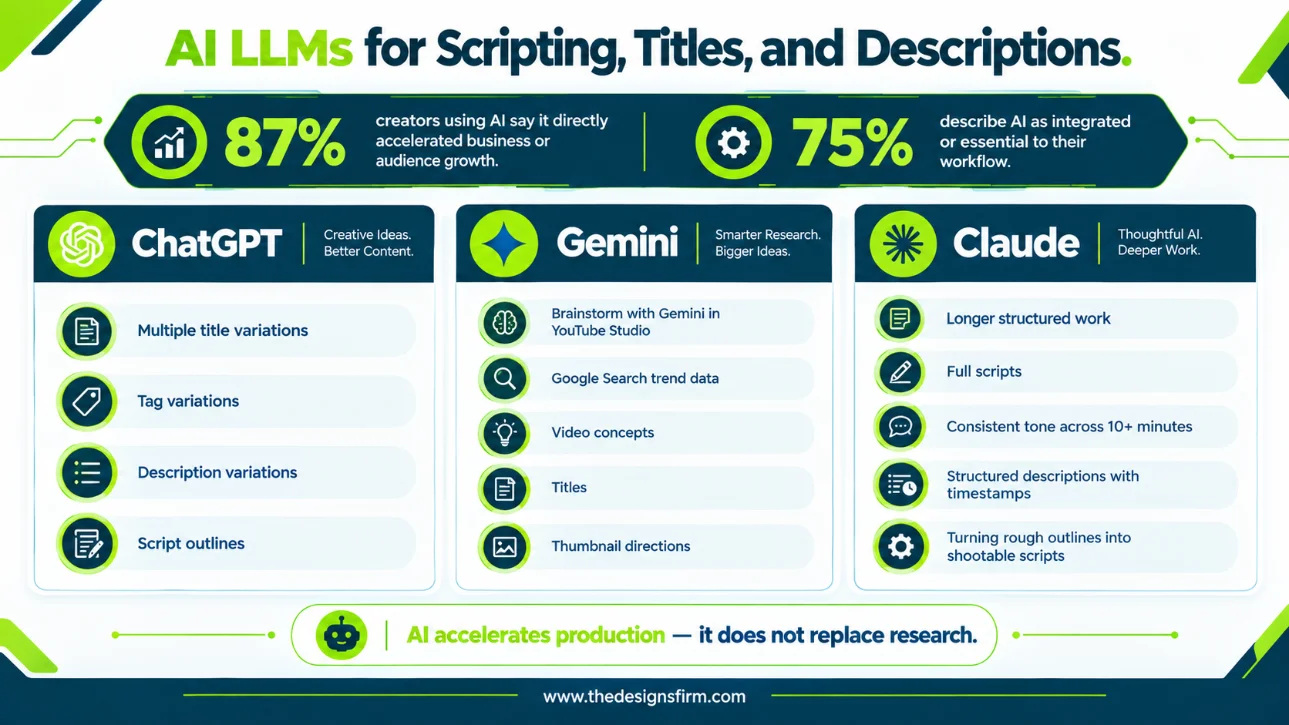
This is the layer most YouTube SEO guides still miss, and it’s become one of the highest-leverage additions to the stack. Adobe’s 2026 Creators’ Toolkit Report, a survey of more than 16,000 creators across eight countries, found that 87% of creators using AI tools say it has directly accelerated the growth of their business or audience, and 75% now describe AI as integrated or essential to how they work.
Each model has a slightly different edge for YouTube work:
- ChatGPT is fast at generating multiple title, tag, and description variations, and at outlining a script from a one-line idea.
- Gemini is Google’s own model, which is why YouTube is testing “Brainstorm with Gemini” directly inside Studio. It can pull from Google Search trend data to suggest concepts, titles, and thumbnail directions grounded in what people are already searching for.
- Claude is better suited to longer, structured work: full scripts that hold a consistent tone across ten-plus minutes, structured descriptions with timestamps, and turning a rough outline into a shootable script.
None of the three replace the research step. They work fastest, and most accurately, when fed a keyword or competitor insight from vidIQ, TubeBuddy, or NexLev first, rather than asked to invent a topic from nothing.
Thumbnails: Where Canva Still Earns a Spot
Thumbnail quality is one of YouTube’s own ranking factors alongside watch time and CTR, and it’s the one part of the job that’s still primarily visual rather than data-driven. Canva remains the fastest way for a non-designer to produce a clean, high-contrast, mobile-legible thumbnail, with a template library built around YouTube’s 1280×720 format. Pair it with the A/B testing in TubeBuddy or vidIQ, and a thumbnail moves from “one we like” to “the one the data says performs.”
If you want to explore alternatives to Canva, our roundup of the best visual content creation tools is a good place to start.
Hybrid Workflows: Why Stacking Tools Outperforms Using One
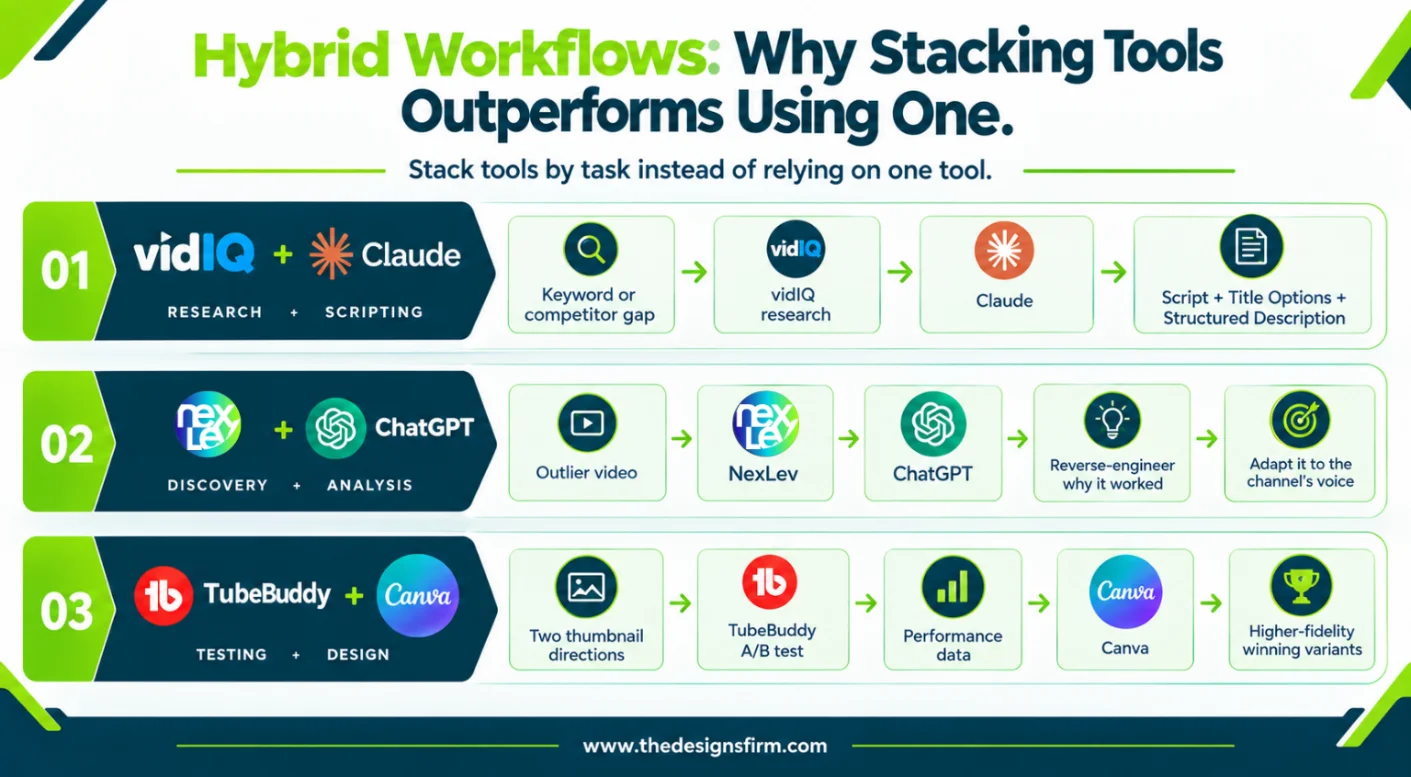
The real shift in YouTube SEO over the past two years isn’t a single new tool. It’s that the best-performing channels stopped picking one tool and started stacking them:
- vidIQ + Claude: Pull a keyword or competitor gap from vidIQ’s research tab, then hand that context to Claude to draft the script, title options, and a structured description in one pass.
- NexLev + ChatGPT: Find an outlier video in the niche through NexLev, then use ChatGPT to reverse-engineer why it worked and outline a version adapted to your channel’s voice.
- TubeBuddy + Canva: Run a TubeBuddy A/B test on two thumbnail directions, then use Canva to produce the winning concept in higher-fidelity variants for future videos.
None of these combinations need an enterprise budget. Most run comfortably on free tiers plus a single AI subscription, and if you want to round out the stack beyond YouTube, we’ve covered the best digital marketing tools worth considering.
How to Build Your Stack Based on Where Your Channel Is
- Just starting out: Master YouTube Studio and Google Trends first. They’re free, and they teach you to read your own data before paying a tool to summarize it for you.
- Publishing consistently, ready to optimize: Add one of vidIQ or TubeBuddy, not both at once, for keyword research and A/B testing, plus ChatGPT or Claude to speed up scripting and metadata.
- Competing in a crowded niche: Add NexLev to study outlier videos and monetization potential across the niche, not just your own channel’s history.
- Agency or multi-channel operations: Run the full stack (vidIQ and TubeBuddy for optimization, NexLev for competitive intelligence, and AI assistants for production speed) with A/B test results, not any tool’s built-in “SEO score,” as the final word.
Our Approach at The Design Firm
At The Design Firm, we don’t run a channel’s growth off any single tool’s dashboard. We start with YouTube Studio and Google Trends to understand what an audience is actually searching for, layer in vidIQ or TubeBuddy to close specific optimization gaps, and bring in NexLev when a niche needs outlier research beyond a client’s own upload history. AI assistants speed up production, but every title, thumbnail, and description still gets validated against real CTR and retention data before we call it finished. Tools inform the strategy; they don’t replace it.
If you’d rather have specialists handle this for your channel, our team offers YouTube SEO services in Pakistan covering keyword research, video optimization, and ongoing performance tracking.
Conclusion
YouTube SEO in 2026 is won with tools built around watch time, CTR, and audience retention, used together instead of one at a time. Start with what’s free, add one optimization suite before adding two, bring in NexLev once competitor research becomes the bottleneck, and let an AI assistant handle the drafting, never the strategy. Do that consistently, and the roughly 30% CTR gains from search-intent-driven titles aren’t hypothetical. They’re the direct result of matching the right tool to the right part of the job.