
Top 17 Content Creation Ideas That Actually Work

Content creation ideas work best when they solve a real audience problem, support a clear business goal, and fit the platform where people will consume them. The strongest ideas can become more than one asset: a research report can become a blog post, infographic, video, and social content, while customer questions can become FAQs, guides, and sales enablement content. At The Design Firm, we focus on ideas that combine audience insight, search demand, originality, and measurable business value rather than creating content simply to maintain a publishing schedule.
Key Takeaways
- Start with audience problems, customer questions, search behaviour, and business objectives rather than random topics.
- Mix educational, visual, interactive, research-driven, customer-led, and video content to reach people at different stages of the buying journey.
- Original research, expert insights, case studies, tools, and first-hand experience can make content substantially more useful and distinctive.
- Repurpose strong content into multiple formats, but adapt each version to its platform instead of copying it everywhere.
- Use AI to accelerate research, ideation, production, and repurposing while keeping human expertise, fact-checking, originality, and editorial judgement in control.
Table of Contents
Why Content Creation Needs More Than a List of Topics
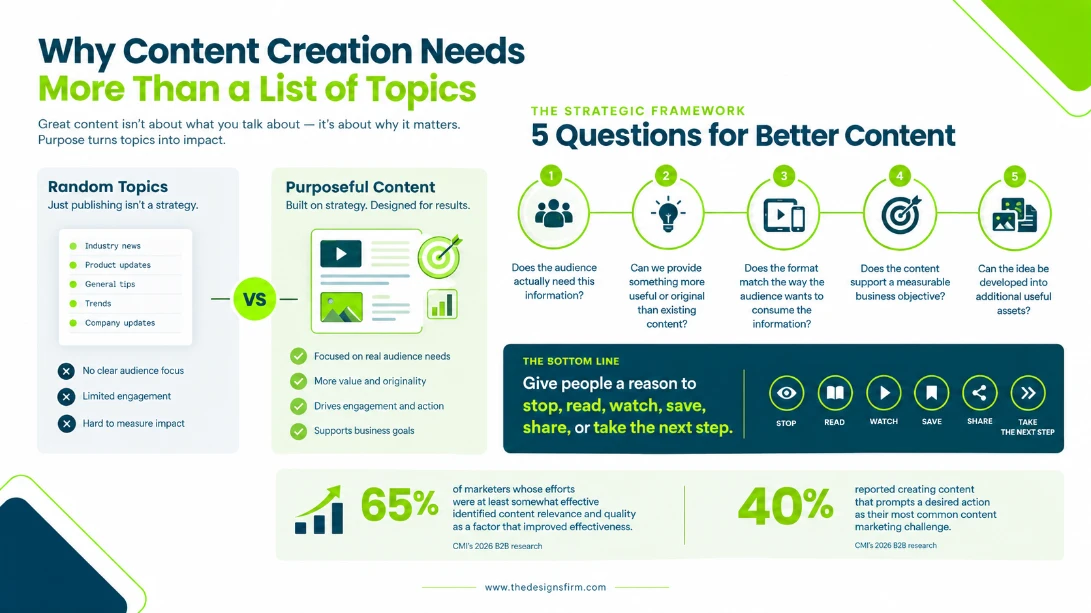
Publishing more content does not automatically produce better marketing results. The challenge is creating content that gives people a reason to stop, read, watch, save, share, or take the next step.
Current research reinforces this point. In CMI’s 2026 B2B research, 65% of marketers whose efforts were at least somewhat effective identified content relevance and quality as a factor that improved effectiveness. The same research found that creating content that prompts a desired action was the most common content marketing challenge, reported by 40% of respondents.
Google’s guidance follows a similar principle: content should be created primarily to help people, provide original value, demonstrate relevant expertise, and leave the reader satisfied rather than being produced primarily to manipulate search rankings.
For businesses that rely on organic visibility, a structured SEO approach can help connect useful content with the people searching for it. This includes aligning content with relevant search intent, improving on-page elements, and building a consistent strategy around organic growth. Businesses that need additional expertise can also work with professional SEO agency to develop and maintain these efforts. Content should support the broader strategy rather than exist as a separate publishing exercise.
That gives us a useful framework for evaluating content ideas:
- Does the audience actually need this information?
- Can we provide something more useful or original than existing content?
- Does the format match the way the audience wants to consume the information?
- Does the content support a measurable business objective?
- Can the idea be developed into additional useful assets?
With those principles in place, here are 17 content creation ideas worth testing.
17 Content Creation Ideas for Businesses
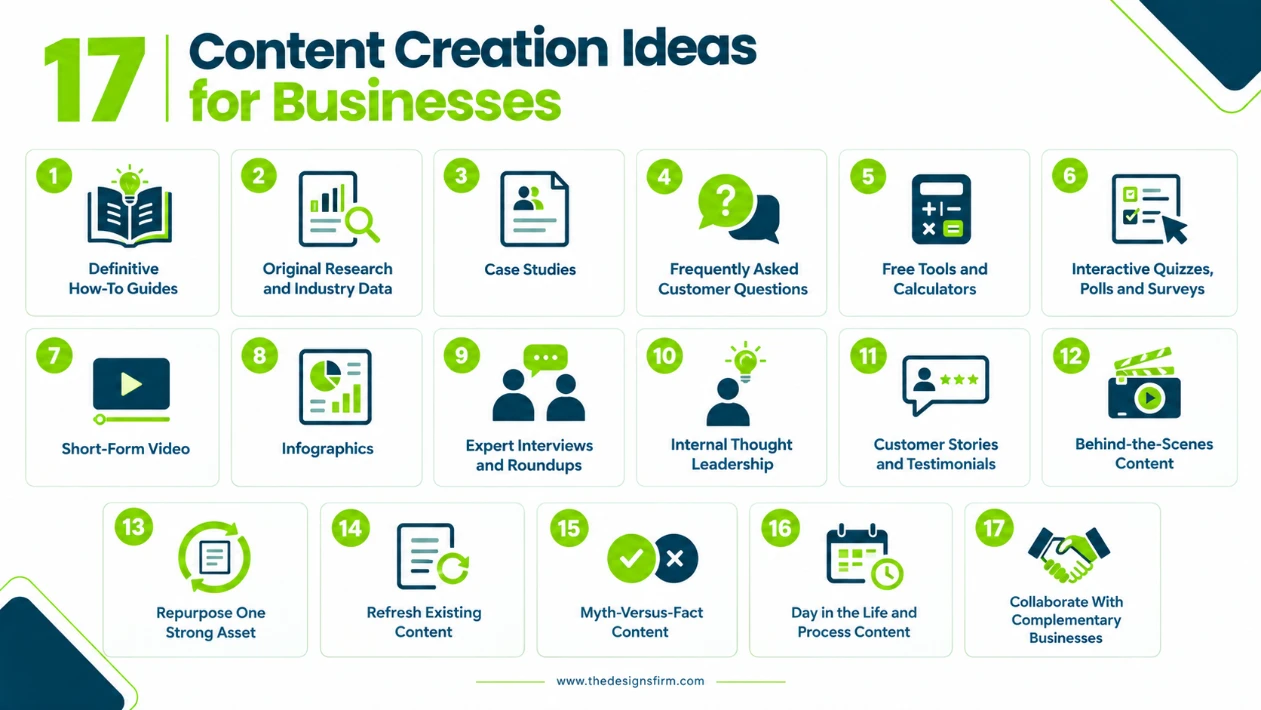
1. Create Definitive How-To Guides
A detailed how-to guide can turn a complex process into a practical resource.
Instead of publishing a generic article such as “Tips for Better Email Marketing,” build something that explains exactly how to plan, create, launch, measure, and improve an email campaign.
Strong how-to guides should include:
- A clear outcome
- Step-by-step instructions
- Examples
- Screenshots or visuals where useful
- Common mistakes
- Practical recommendations
- Relevant tools or resources
- Answers to related questions
For SEO, do not make a guide long simply to increase word count. Google explicitly states that it does not have a preferred word count. The objective should be completeness and usefulness, not length for its own sake.
Businesses developing content around search demand can also benefit from professional keyword research services to identify the questions, topics, and search patterns worth addressing.
2. Publish Original Research and Industry Data
Original research gives your brand something competitors cannot simply rewrite.
You could survey customers, analyse your own business data, conduct an industry survey, compare products or services, or identify patterns from a large dataset.
A strong research project can become:
- A research report
- A statistics article
- An infographic
- Social media posts
- A presentation
- A webinar
- PR outreach
- Expert commentary
- Sales materials
Original data can also make your content more useful to journalists and publishers. Muck Rack’s 2026 State of Journalism found that 40% of journalists said original data or research is something a PR professional should ideally offer alongside a story pitch.
The key is to publish methodology and context so readers can understand where the data came from and what it actually means.
If the findings are highly visual, professional infographic and graphic design services can help turn complex research into a format that is easier to understand and share.
3. Turn Real Results Into Case Studies
Case studies connect your service or product to a real-world outcome.
A useful case study should explain:
- The customer’s situation
- The problem or objective
- The approach taken
- Important implementation details
- Obstacles encountered
- Measurable outcomes
- Lessons that other businesses can apply
Avoid turning every case study into a sales pitch. The educational value should be strong enough that someone who is not ready to buy can still learn from it.
For an agency, this format is especially useful because it demonstrates how strategy was applied rather than simply claiming expertise. Well-written case studies can also be supported by professional copywriting services when the subject involves technical or complex business information.
4. Answer Frequently Asked Customer Questions
Your existing customers can provide an almost unlimited source of content ideas.
Review:
- Sales calls
- Customer support conversations
- Contact form submissions
- Emails
- Product reviews
- Search queries
- Social media comments
- Questions asked by prospects
Then turn recurring questions into useful content.
For example, a web development company could create separate resources around website costs, development timelines, CMS selection, maintenance, security, integrations, and migration.
This approach also helps you build content around genuine informational needs rather than inventing topics based solely on keyword volume.
5. Build Free Tools and Calculators
A useful tool can become a recurring destination rather than a one-time piece of content.
Examples include:
- ROI calculators
- Pricing calculators
- Mortgage calculators
- Percentage calculators
- Audit tools
- Planning templates
- Assessment tools
- Generators
- Checklists
- Comparison tools
The best tools solve a specific problem with minimal friction.
A simple calculator that people actually use can be more valuable than a lengthy article that repeats information available elsewhere.
Interactive tools can also contribute to first-party data collection when they are designed responsibly. CMI’s 2026 B2B research found that 68% of B2B marketers collect first-party data through content-driven methods such as gated assets, webinars, and interactive tools.
6. Create Interactive Quizzes, Polls, and Surveys
Interactive content gives your audience a reason to participate instead of simply consume.
You can create:
- Knowledge quizzes
- Product recommendation quizzes
- Industry polls
- Audience surveys
- Self-assessments
- Readiness assessments
- Preference questionnaires
The most useful interactive content produces an outcome for the participant.
For example, instead of asking “Which marketing channel do you prefer?” create a short assessment that helps a business identify which digital marketing channels may deserve more attention.
The responses can also reveal audience concerns and generate ideas for future content. A broader understanding of how to choose digital marketing channels can help businesses decide where different content formats are most appropriate.
7. Use Short-Form Video to Explain One Thing
Short-form video works particularly well when it focuses on one specific question, process, tip, example, or misconception.
Possible formats include:
- One-minute tutorials
- Quick answers
- Before-and-after demonstrations
- Product tips
- Screen recordings
- Expert explanations
- Myth-versus-fact videos
- Short customer stories
- Behind-the-scenes clips
Video remains a major part of modern content strategies. Wyzowl’s 2026 research found that 91% of businesses use video as a marketing tool, while 63% of video marketers reported using AI video tools to help create or edit marketing videos.
The lesson is not to create video simply because video is popular. Choose topics where seeing the process or hearing an explanation adds value.
For businesses producing regular video assets, professional video and animation services can support production across social, website, advertising, and educational content.
8. Turn Complex Information Into Infographics
Infographics are useful when the information is easier to understand visually than through paragraphs.
Good subjects include:
- Statistics
- Processes
- Timelines
- Comparisons
- Frameworks
- Checklists
- Step-by-step workflows
- Research findings
- Industry trends
A strong infographic should have one clear purpose. Do not combine unrelated statistics simply because they look good together.
For SEO and accessibility, important information should also exist as HTML text on the page rather than being locked exclusively inside an image.
When a visual asset needs to support a wider brand identity, professional branding services can help maintain consistency across infographics, presentations, social graphics, and other marketing materials.
9. Publish Expert Interviews and Roundups
Bring multiple perspectives into one piece of content by interviewing specialists or asking several experts the same focused question.
For example:
“12 SEO Experts Explain How They Approach Content Refreshes in 2026.”
The value comes from the quality of the contributors and the question—not from simply collecting as many names as possible.
You can also repurpose the interviews into:
- Individual expert quotes
- Short videos
- Social posts
- Podcast episodes
- Email content
- Follow-up articles
This is particularly effective for thought leadership because it combines external expertise with your editorial perspective.
10. Create Thought Leadership From Internal Expertise
Your company’s subject-matter experts are often one of your most underused content resources.
Instead of publishing another generic article, ask an experienced team member:
- What do competitors misunderstand about this topic?
- What mistakes do clients repeatedly make?
- What has changed in the industry?
- Which common recommendation do you disagree with?
- What have you learned from working on real projects?
- What would you do differently today?
Then turn those answers into original content.
CMI’s 2026 research found that 96% of B2B marketers create thought leadership content, but employee participation remains limited at many organisations. Only 10% reported widespread participation from employees with specialised knowledge or expertise.
That creates an opportunity for businesses to bring more genuine expertise into their content.
For organisations that need ongoing material across several channels, professional content marketing services can help connect expert knowledge with a structured editorial programme.
11. Publish Customer Stories and Testimonials
Customer-led content can show how a product or service fits into a real situation.
You can create:
- Written testimonials
- Video testimonials
- Customer interviews
- Before-and-after stories
- Customer spotlights
- Implementation stories
- “Why we chose…” interviews
Video is particularly useful when customers need to explain a complex experience or demonstrate a product.
Wyzowl’s 2026 research found that testimonial videos were used by 57% of video marketers. It also found that 89% of consumers said video quality affects their trust in a brand.
Authenticity matters more than making every testimonial look like a television commercial.
12. Show Behind-the-Scenes Content
Behind-the-scenes content makes an organisation more tangible by showing the people, processes, and decisions behind the finished product.
Depending on the business, this could include:
- A production process
- A project kickoff
- Design iterations
- Office operations
- Employee expertise
- Product development
- Event preparation
- Packaging
- Quality checks
This format is especially useful for brands whose customers rarely see what happens before delivery.
The goal should be to reveal something meaningful—not simply show employees sitting at their desks.
13. Repurpose One Strong Asset Into Multiple Formats
Repurposing allows your team to extract more value from research and production work.
For example, one original research report could become:
- A detailed report
- A summary article
- An infographic
- Five LinkedIn posts
- A short-form video series
- A webinar
- An email sequence
- Sales presentation slides
Repurposing is becoming increasingly important as marketers manage more channels. HubSpot’s 2026 State of Marketing identifies repurposing content across channels as one of the leading trends reported by marketers.
The same principle can be applied to social distribution. Depending on the audience, businesses can adapt one core idea for different social platforms while adjusting the creative approach and messaging for each platform.
However, repurposing does not mean copying and pasting the same content everywhere. Each version should be adapted to its platform and audience.
14. Refresh Existing Content That Has Become Outdated
Your next content opportunity may already exist on your website.
Review older pages for:
- Outdated statistics
- Broken links
- Old screenshots
- Discontinued products
- Changed recommendations
- Missing sections
- Weak examples
- Search intent changes
- New competitor coverage
- New industry developments
Then make substantive improvements.
Do not simply change the publication date. Google’s guidance specifically warns against changing dates to make content appear fresh when the underlying content has not been substantially updated.
A genuine refresh should improve the resource for today’s reader.
Before beginning a large content refresh, a professional website audit can help identify technical, content, and optimisation issues that may affect the performance of existing pages.
15. Create Myth-Versus-Fact Content
Every industry has misconceptions that can become useful content.
A myth-versus-fact format works particularly well when:
- The misconception is common
- The correction can be supported with evidence
- The subject affects purchasing decisions
- The myth causes customers to make mistakes
For example:
Myth: SEO is only about keywords.
Fact: Modern SEO also involves content quality, search intent, technical accessibility, internal linking, user experience, and demonstrating useful expertise.
The strongest version of this format explains why the myth is wrong rather than simply presenting a provocative headline.
16. Create “Day in the Life” and Process Content
A “day in the life” series can showcase the people behind a business while providing useful insight into how work actually gets done.
You could follow:
- A designer
- SEO specialist
- Developer
- Sales representative
- Project manager
- Photographer
- Engineer
- Consultant
The content can work as video, social posts, photo stories, or longer articles.
For service businesses, process-focused content can also help prospective customers understand what happens after they sign a contract.
17. Collaborate With Complementary Businesses
Find businesses that serve the same audience without directly competing with you.
Potential collaborations include:
- Joint webinars
- Expert interviews
- Co-authored guides
- Research projects
- Industry reports
- Podcasts
- Workshops
- Cross-promotional campaigns
The important part is creating something useful enough that both audiences have a reason to engage.
For example, an accounting firm could collaborate with a business lawyer on a guide covering the financial and legal considerations of starting a company.
The partnership should add expertise, not just increase the number of logos on the page.
How to Choose the Right Content Creation Idea
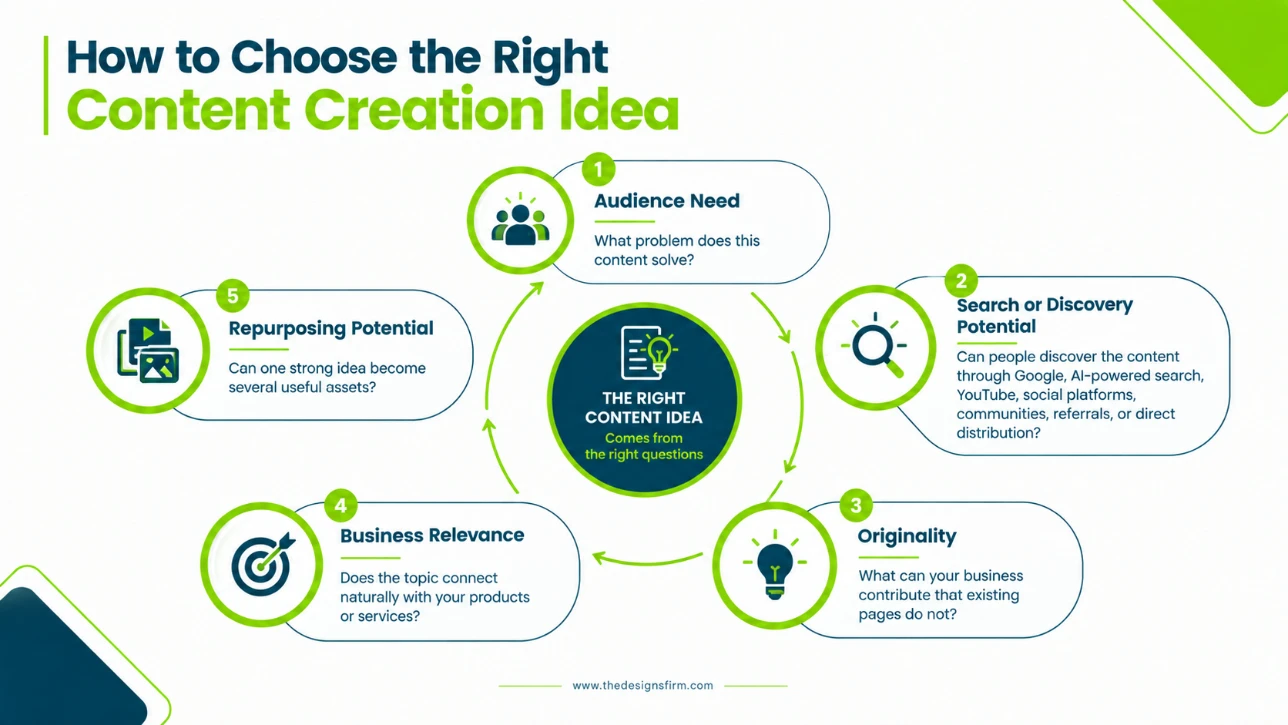
A list of 17 ideas is useful only if you know which idea to use next.
At The Design Firm, we recommend evaluating potential ideas against five practical questions:
Audience Need
What problem does this content solve?
If the answer is unclear, the idea probably needs more research.
Search or Discovery Potential
Can people discover the content through Google, AI-powered search, YouTube, social platforms, communities, referrals, or direct distribution?
Search volume is useful, but it should not be the only consideration. A topic with a smaller audience can still be valuable if it reaches people with strong commercial intent.
As search behaviour continues to evolve, businesses may also need to consider answer-focused discovery. An AEO and AI search optimisation service can help organisations adapt content for emerging search experiences.
Originality
What can your business contribute that existing pages do not?
This could be:
- Original data
- First-hand experience
- Expert commentary
- Unique examples
- Proprietary methodology
- Customer insights
- Better visualisation
- A useful tool
Google’s people-first guidance specifically encourages original information, research, analysis, and substantial additional value rather than simply rewriting what other sources have already published.
Business Relevance
Does the topic connect naturally with your products or services?
A business does not need every piece of content to sell something directly. But a content strategy should collectively support awareness, consideration, conversion, retention, or another defined business objective.
For businesses targeting customers in a specific geographic market, local SEO services can complement locally relevant content and help connect location-based searches with useful website resources.
Repurposing Potential
Can one strong idea become several useful assets?
If an idea can generate a detailed article, video, infographic, social posts, email content, and sales material, its production value may be considerably higher than a one-format idea.
How We Build a Content Creation Workflow
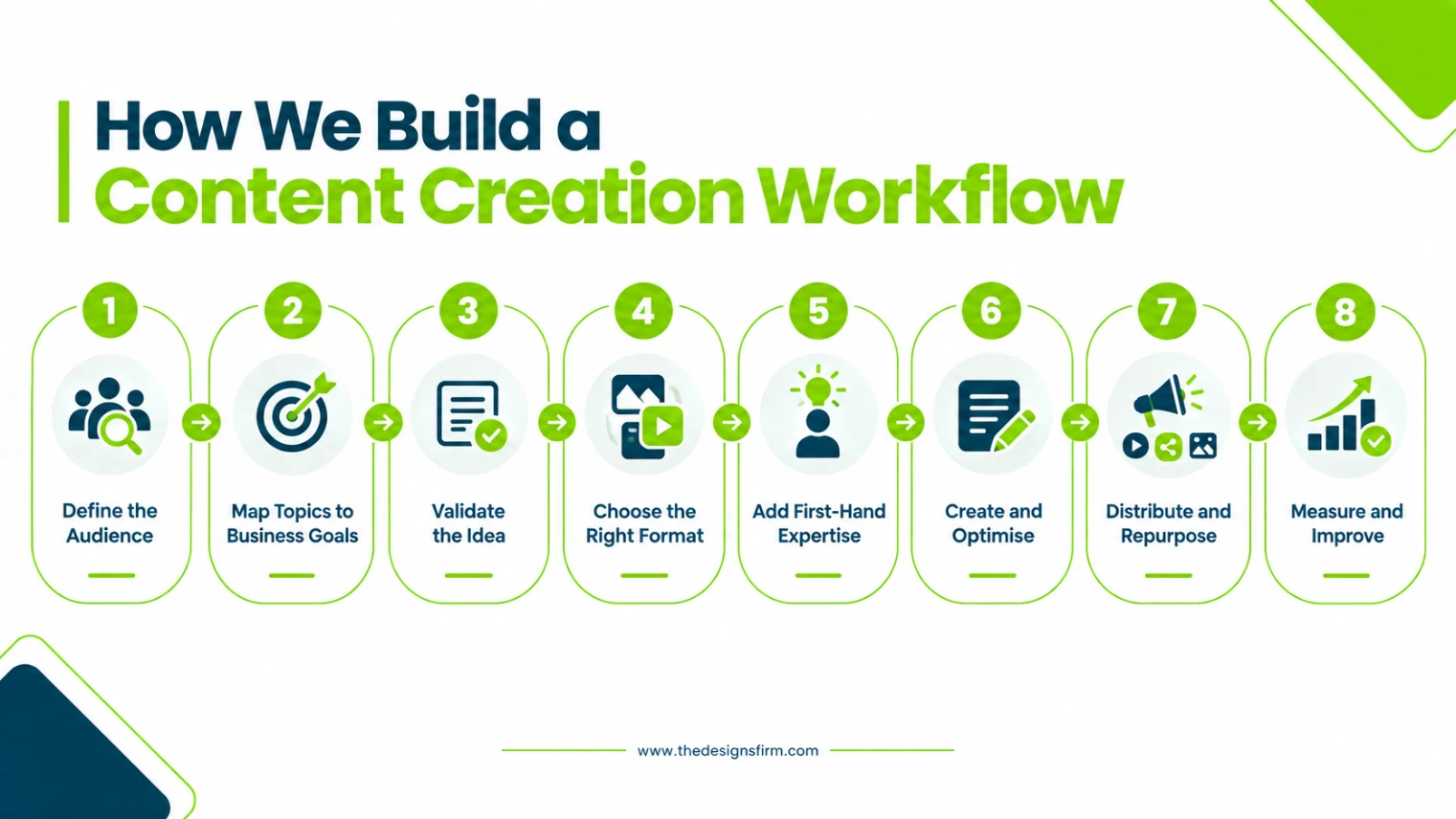
Great content ideas still need a repeatable production system.
Our approach starts with research rather than a blank content calendar.
1. Define the Audience
Identify who the content is for, what they need, what they already know, and what problems they are trying to solve.
2. Map Topics to Business Goals
Connect topics with awareness, consideration, conversion, customer education, retention, or another measurable objective.
3. Validate the Idea
We review search behaviour, competitors, existing content, customer questions, industry developments, and available first-party insights.
4. Choose the Right Format
The same topic can require very different formats.
A complex process may work as a guide or video. A statistical finding may work as an infographic. A decision-making problem may work better as an interactive calculator.
5. Add First-Hand Expertise
Bring in subject-matter experts, customer experiences, proprietary data, original examples, or documented processes wherever possible.
6. Create and Optimise
The content should be clear and useful first, then optimised for discoverability through appropriate headings, internal links, metadata, structured information, and other relevant SEO practices.
For websites that need broader optimisation beyond content itself, on-page SEO services can address elements such as page structure, metadata, internal linking, and content relevance.
7. Distribute and Repurpose
Publishing is not the end of the workflow. We adapt strong assets for relevant channels rather than relying on organic search alone.
A coordinated distribution plan may include email, search, social media, video, and paid campaigns. Businesses looking to manage multiple digital channels can also explore digital marketing packages that bring different activities together within a broader strategy.
8. Measure and Improve
Track the metrics that match the objective. Depending on the asset, that could include organic traffic, engagement, leads, assisted conversions, rankings, backlinks, video engagement, downloads, or sales influence.
This measurement loop matters because content strategy should evolve based on evidence rather than assumptions. CMI’s 2026 research found that 61% of B2B marketers reported improved content strategy effectiveness, with 74% of those marketers attributing improvement to strategy refinement.
How AI Fits Into Modern Content Creation
AI can make content production faster, but it should not become a substitute for strategy or expertise.
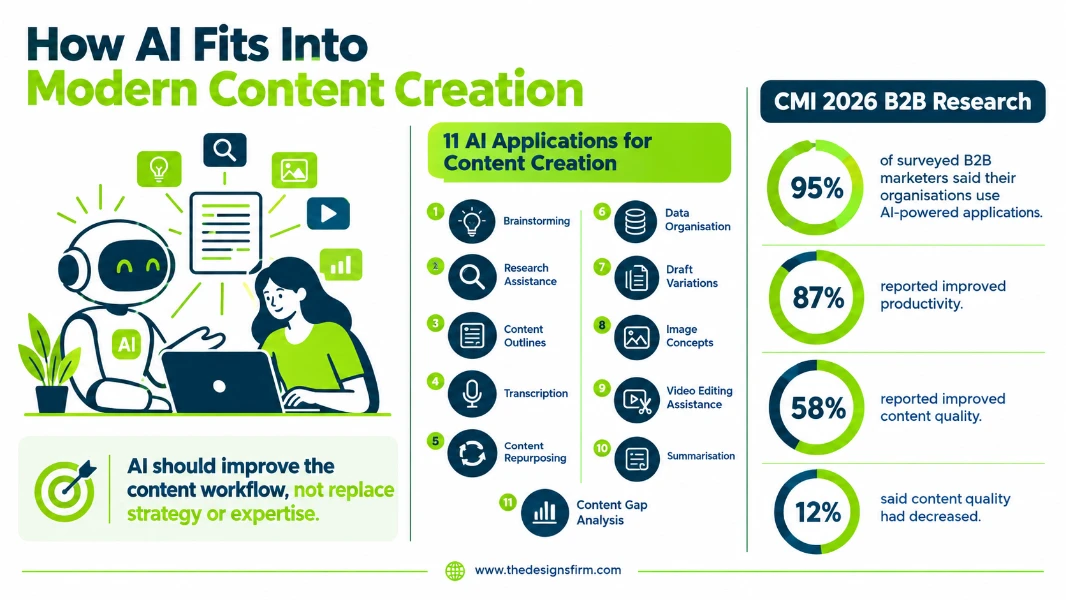
Modern teams can use AI for:
- Brainstorming
- Research assistance
- Content outlines
- Transcription
- Content repurposing
- Data organisation
- Draft variations
- Image concepts
- Video editing assistance
- Summarisation
- Content gap analysis
The important distinction is between using AI to improve a content workflow and using AI to mass-produce generic content.
CMI’s 2026 B2B research found that 95% of surveyed B2B marketers said their organisations use AI-powered applications. Among marketers using AI for content creation, 87% reported improved productivity, while 58% reported improved content quality. At the same time, 12% said content quality had decreased.
That is why human review remains essential.
At The Design Firm, we see AI as a production and research assistant rather than the source of strategy. The strongest content still requires people who understand the audience, industry, brand, evidence, and business objective.
Common Content Creation Mistakes to Avoid
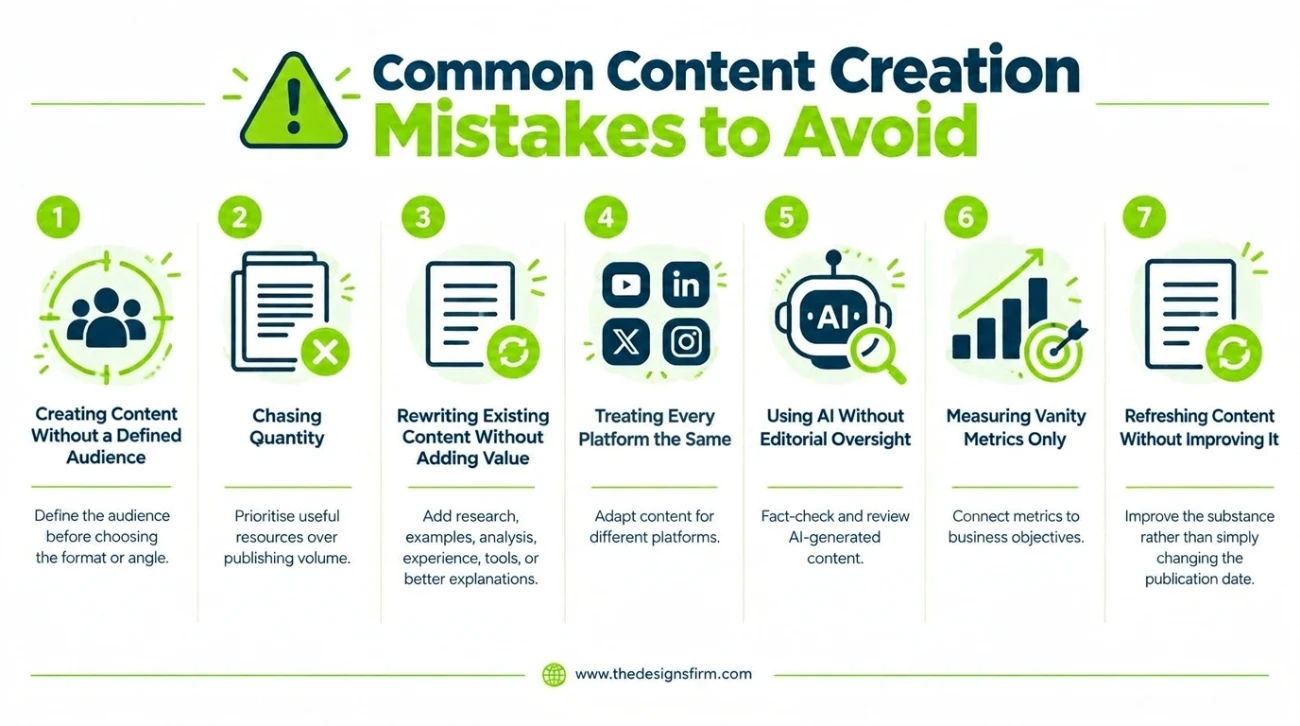
Creating Content Without a Defined Audience
A topic that appeals to everyone often becomes useful to no one. Define the audience before choosing the format or angle.
Chasing Quantity
Publishing three weak articles instead of one genuinely useful resource does not create a stronger content strategy.
Rewriting Existing Content Without Adding Value
Changing the wording of information that already exists elsewhere does not automatically make it original. Add research, examples, analysis, experience, tools, or a genuinely better explanation.
Treating Every Platform the Same
A blog article, LinkedIn post, Instagram Reel, YouTube video, and email newsletter have different user expectations. Adapt the content instead of distributing identical copies.
Using AI Without Editorial Oversight
AI can introduce inaccurate facts, generic claims, repetitive language, or unsupported conclusions. Human review and source verification remain necessary.
Measuring Vanity Metrics Only
Views and likes can provide useful signals, but they do not necessarily demonstrate business value. Connect measurement to the purpose of the content.
Refreshing Content Without Improving It
A new date does not make old information useful. Update the substance, examples, evidence, structure, and recommendations when the topic has changed.
Conclusion
The best content creation ideas are not necessarily the most complicated ones. A well-researched guide, original study, useful calculator, expert interview, customer story, or short explanatory video can all become valuable marketing assets when they solve a real problem.
At The Design Firm, we recommend building your content strategy around audience needs, business objectives, originality, and measurable outcomes. Use the 17 ideas above as a starting point, then identify which formats match your customers, resources, expertise, and distribution channels. Combine strong research with human expertise, use AI where it genuinely improves the workflow, repurpose your best work intelligently, and keep refining the strategy based on performance.
The goal is not to create more content. It is to create content worth finding, reading, watching, using, and remembering.