
11 Powerful Link Building Strategies for Modern SEO

Link building is the process of earning links from other websites to your own. In modern SEO, effective link building is less about collecting a large number of backlinks and more about earning relevant, editorially justified links that help users discover useful content. Research from Ahrefs has found a positive correlation between the number of unique websites linking to a page and its search traffic, although correlation does not prove that links alone caused the traffic. At the same time, Google actively identifies and restricts manipulative link-building practices.
Key Takeaways
- Focus on earning links from relevant, trustworthy websites rather than maximizing backlink volume.
- Create useful assets that publishers, journalists, and other websites have a genuine reason to reference.
- Use guest posting, digital PR, HARO, link reclamation, and relationship-based outreach strategically.
- Avoid paid links, excessive link exchanges, automated link building, and other tactics designed primarily to manipulate rankings.
- Measure link-building success using relevance, referring domains, qualified traffic, and business outcomes—not just Domain Rating or backlink count.
Table of Contents
What Is Link Building in SEO?
Link building is the process of acquiring hyperlinks from external websites that point to pages on your website. For businesses aiming to scale their search visibility efficiently, investing in professional link building services can streamline this entire process.
For example, if an industry publication references one of our research reports and links to the report on our website, that is a backlink.
Backlinks can help people discover your content and can contribute to how search engines understand relationships between pages across the web. However, the value of a backlink depends heavily on its context, relevance, and the quality of the website and page providing it.
That is why modern link building should not be treated as a numbers game.
Ahrefs’ 2026 SEO statistics research reports a positive correlation between the number of websites linking to a page and its search traffic. It also reports that pages ranking higher in Google tend to acquire more new followed referring domains. These findings show an association rather than proving that backlinks directly caused higher rankings or traffic.
What Makes a Backlink Valuable?
Not every backlink deserves the same attention.
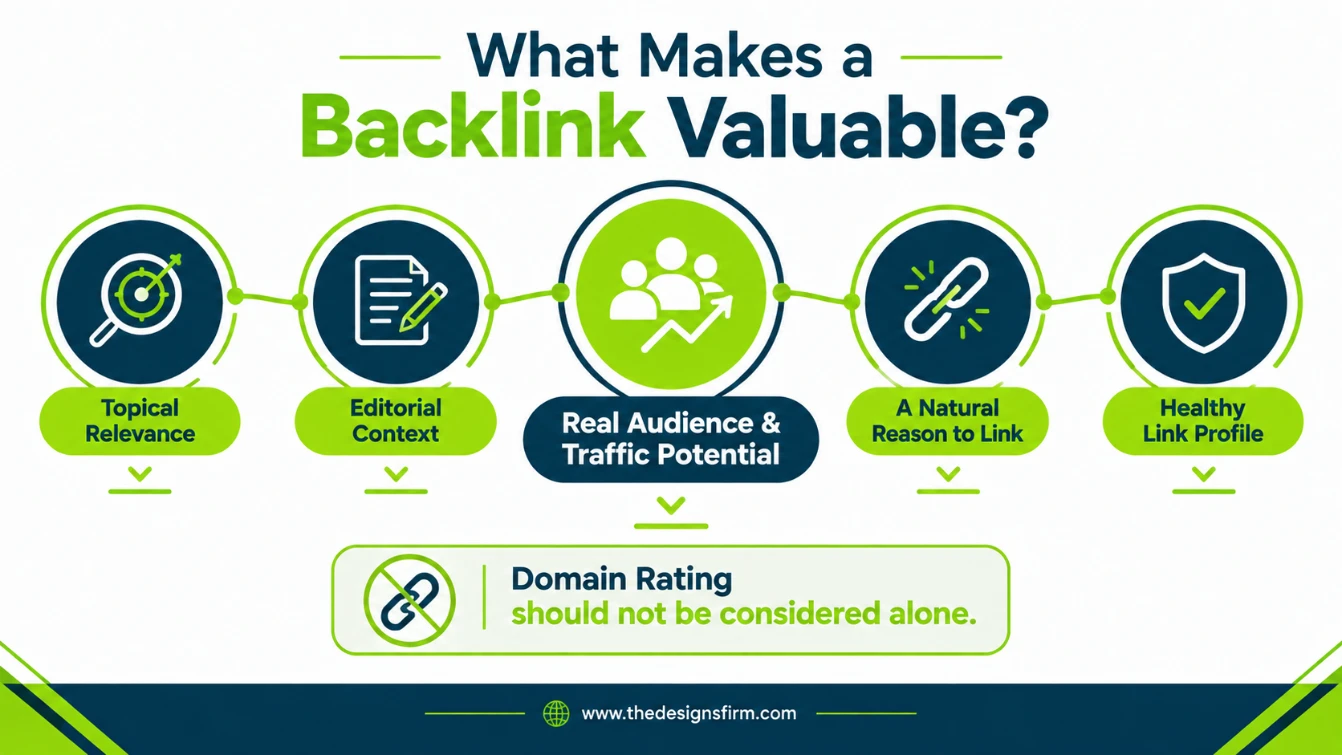
When evaluating a link-building opportunity, we look beyond metrics such as Domain Rating and ask whether the link makes sense for the audience, page, and business.
1. Topical Relevance
A link from a website that regularly covers your industry or a closely related subject is generally more meaningful than a random link from an unrelated website.
For example, a cybersecurity company would have a natural reason to earn links from technology publications, security researchers, software companies, or business publications discussing cybersecurity.
Relevance should come before metrics.
2. Editorial Context
A link placed naturally within useful editorial content is different from a link inserted solely because someone wants to manipulate rankings.
The surrounding content should explain why the linked resource is useful to the reader.
3. Real Audience and Traffic Potential
A website can have strong SEO metrics without providing much real value to your business.
A useful prospect may have an established audience, relevant content, and the potential to send qualified referral traffic.
4. A Natural Reason to Link
The strongest opportunities usually exist because your content genuinely adds something to another publisher’s page.
That could be original research, a useful guide, an expert quote, a tool, a case study, a statistic, or another resource worth referencing.
5. Healthy Link Profile
Do not judge an opportunity by Domain Rating alone.
Ahrefs describes Domain Rating as a measure of backlink-profile strength and recommends pairing it with other indicators because DR is not a standalone measure of website quality or legitimacy.
11 Modern Link Building Strategies That Actually Make Sense
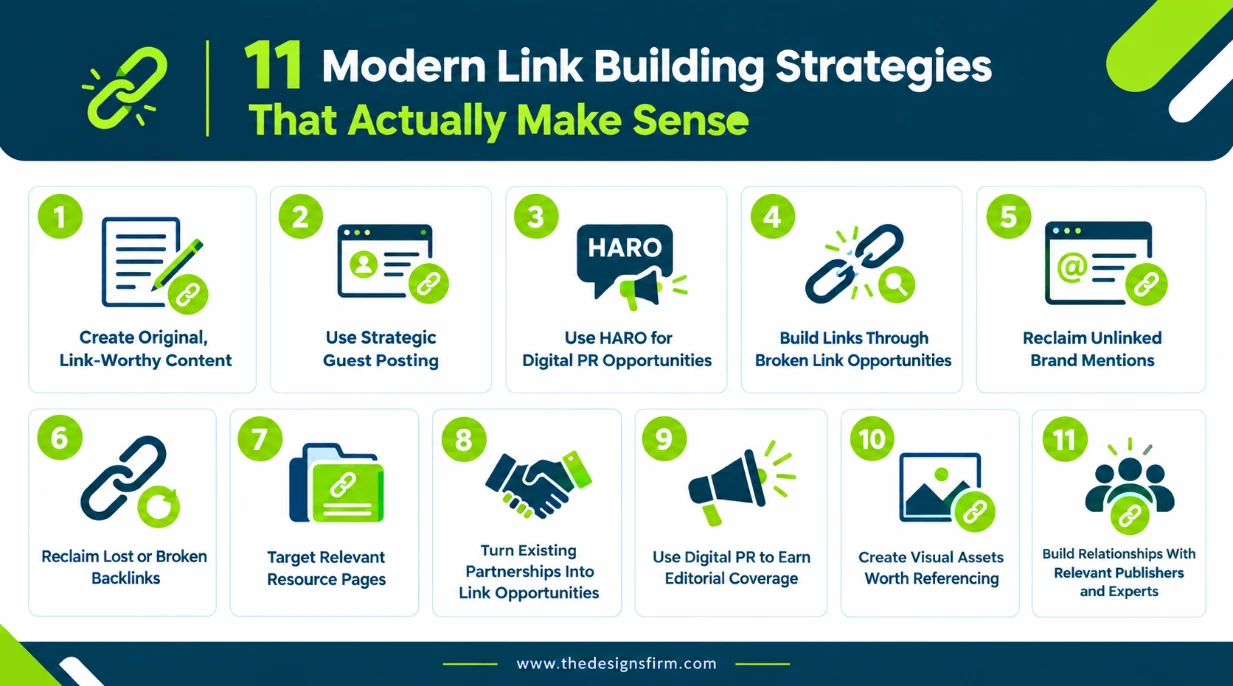
1. Create Original, Link-Worthy Content
The foundation of sustainable link building is creating something other websites have a reason to reference.
Instead of publishing another generic 1,500-word article on a topic that has already been covered hundreds of times, brainstorm new content creation ideas and look for ways to add information that is difficult to find elsewhere.
That could include:
- Original research
- Industry surveys
- Expert interviews
- Proprietary data
- Detailed guides
- Calculators and tools
- Templates
- Checklists
- Original illustrations
- Case studies
- Benchmark reports
- Statistical roundups
- Comprehensive resource pages
For example, if we publish a study containing original data about e-commerce conversion rates, other marketers may reference the findings in their own articles.
The important distinction is that we are creating something worth citing—not simply publishing content because we want another backlink.
Make Content Easy to Reference
If you want publishers to cite your research, make the important information easy to find. By learning how to create high-quality linkable assets, you ensure the information is structured perfectly for external citation.
Use clear headings, concise statistics, charts, tables where appropriate, expert quotations, and direct explanations.
The easier it is for another writer to understand and reference your information, the more useful the asset becomes as a link-building resource.
2. Use Strategic Guest Posting
Guest posting can still be useful when the primary goal is contributing valuable expertise to a relevant publication.
The mistake is treating guest posting as a system for producing large volumes of keyword-rich backlinks.
Instead, identify publications that:
- Cover your industry or target audience
- Publish genuine editorial content
- Have an established readership
- Accept expert contributions for legitimate editorial reasons
- Maintain reasonable editorial standards
- Provide useful exposure beyond the backlink itself
Then pitch a specific topic that fits the publication.
The article should be useful even if the backlink did not exist.
Avoid Guest Post Link Schemes
According to Google’s spam policies, the search engine classifies paid links intended to manipulate rankings, excessive link exchanges, and certain optimized links in guest posts or distributed articles as examples of link spam.
If a placement is paid advertising rather than an editorial endorsement, the publisher should qualify the link appropriately. Google recommends using specific tags to qualify outbound links, such as rel=”sponsored” for paid placements, and also supports rel=”nofollow” for qualifying links.
The goal should be earning editorial visibility, not manufacturing backlinks at scale.
3. Use HARO for Digital PR Opportunities
HARO (Help a Reporter Out) is once again an active source-and-journalist platform.
After Cision retired HARO in 2024, Featured acquired the platform in April 2025, and as noted on the Featured About page, relaunched it in its original format as a free daily email connecting journalists with expert sources. Featured says the first edition under its ownership was sent on April 22, 2025.
We can use HARO as part of a broader digital PR and link-building strategy by monitoring relevant journalist requests and responding when we can provide genuinely useful expertise.
For example, a journalist may need:
- An SEO expert’s opinion
- A marketing statistic
- A business owner’s experience
- A technical explanation
- An industry trend
- Expert commentary on a specific problem
How to Get Better Results From HARO
Do not respond to every request simply because it could produce a backlink.
Instead:
- Choose queries closely related to your expertise.
- Read the journalist’s requirements carefully.
- Answer the specific question directly.
- Provide original insights rather than generic statements.
- Keep the response concise unless more detail is requested.
- Include relevant credentials when they strengthen your response.
- Never invent experience, data, or claims.
A successful response may result in an editorial mention, expert quote, referral traffic, and potentially a backlink.
HARO should therefore be treated as a digital PR opportunity first and a link-building tactic second.
4. Build Links Through Broken Link Opportunities
Broken link building involves finding relevant pages on other websites that contain links leading to unavailable or broken resources.
If we have a useful resource that genuinely replaces the missing content, we can contact the website owner and suggest our page as an alternative.
For example:
A marketing publication has an article about SEO tools and links to a resource that no longer exists.
We have a current, comprehensive guide covering the same subject.
We can contact the publisher, explain that the existing resource is no longer available, and suggest our guide as a possible replacement.
What Makes This Strategy Work?
The outreach should be useful to the website owner.
Do not send:
“Your link is broken. Please replace it with our link.”
Instead, explain:
- Where the broken link appears
- Why it may no longer work
- What the original resource was about, if clear
- Why our replacement is relevant
The goal is to make the publisher’s job easier.
5. Reclaim Unlinked Brand Mentions
Sometimes websites mention a company, product, service, or expert without linking to the relevant website.
These are potential link-reclamation opportunities.
For example, an article might say:
The Design Firm recommends conducting a technical SEO audit before launching a new website.
But the company name is not linked.
If the publisher already considers the brand relevant enough to mention, requesting a link can be more natural than pitching the company to a completely unrelated website.
How to Find Unlinked Mentions
You can monitor brand mentions using tools such as Google Alerts and SEO platforms that identify newly published pages.
Google Alerts can monitor web content across categories such as news, blogs, video, books, discussions, and other sources.
When you find a relevant unlinked mention:
- Check whether the page is legitimate and relevant.
- Confirm that the mention is genuinely about your brand.
- Identify the most useful page to link to.
- Contact the publisher or author.
- Politely suggest adding the link for readers who want more information.
There is no guarantee the publisher will add the link, but the existing brand mention gives you a legitimate reason to reach out.
6. Reclaim Lost or Broken Backlinks
Not every link-building opportunity requires creating a new link.
You may already have valuable backlinks that have disappeared.
A website may have:
- Deleted the linking page
- Changed the destination URL
- Replaced your resource
- Removed the link during a content update
- Linked to an outdated URL
- Changed its site structure
Implementing effective SEO tracking methods and regular backlink monitoring can help identify these lost opportunities.
How We Handle Lost Links
We first determine why the link disappeared.
If the publisher still references our content but the link points to an outdated URL, a redirect or updated destination may solve the problem.
If the link was intentionally removed, we assess whether there is a legitimate reason to contact the publisher.
The objective is not to recover every lost backlink blindly. Some links disappear because the publisher has intentionally changed its content, and that decision should be respected.
7. Target Relevant Resource Pages
Resource pages exist specifically to help readers find useful information on a particular subject.
For example:
- Industry resource directories
- Educational resource pages
- Professional associations
- Software resource collections
- Local business resources
- University or institutional resources
- Industry-specific guides
If we have a genuinely useful resource that fits the page, we can contact the site owner and suggest it. For companies aiming for long-term growth, integrating outreach with comprehensive SEO services ensures these placements drive meaningful results.
However, relevance is critical.
A page containing hundreds of unrelated links is not automatically a good link-building opportunity.
We should ask:
Would the publisher’s audience actually benefit from our resource?
If the answer is no, the opportunity is probably not worth pursuing.
8. Turn Existing Partnerships Into Link Opportunities
Businesses often overlook websites they already have legitimate relationships with.
Potential opportunities may include:
- Suppliers
- Distributors
- Technology partners
- Professional associations
- Clients
- Industry organizations
- Event partners
- Business communities
- Vendors
For example, if a company is listed as an official partner on another organization’s website but there is no link to its website, that could be a straightforward outreach opportunity.
The key is that the relationship must be genuine.
Do not create artificial partnerships simply to generate links.
Likewise, avoid exchanging links simply because both businesses want backlinks. Google specifically lists excessive link exchanges and partner pages created primarily for cross-linking as examples of link spam.
9. Use Digital PR to Earn Editorial Coverage
Digital PR focuses on creating stories, insights, data, or expert commentary that journalists and publishers genuinely want to cover.
Instead of asking:
“Where can we get a backlink?”
we ask:
“What can we provide that a publisher’s audience would find newsworthy or useful?”
Potential digital PR assets include:
- Original research
- Industry surveys
- Expert commentary
- Data analysis
- Trend reports
- Expert predictions
- Original statistics
- Unique visualizations
- Proprietary studies
The resulting coverage may include brand mentions and links from relevant publications.
Build a Media-Worthy Story
A successful digital PR campaign needs more than a company announcement.
For example, instead of publishing:
“Company X launches a new SEO service.”
we could analyze industry data and produce:
“The State of SEO for Small Businesses: 500 Businesses Surveyed.”
The second concept gives journalists something they can actually discuss and reference.
10. Create Visual Assets Worth Referencing
Investing in professional graphic design services ensures you create useful visual assets that can attract links because they make complex information easier to understand.
Examples include:
- Original infographics
- Industry charts
- Process diagrams
- Statistical visualizations
- Comparison graphics
- Maps
- Timelines
- Flowcharts
- Frameworks
But simply turning an ordinary article into an infographic does not guarantee backlinks.
The asset needs to provide information that other publishers genuinely want to use.
Make Your Visual Assets Easy to Cite
Include:
- A clear title
- Source information
- Publication date where relevant
- Accurate statistics
- Your brand attribution
- A supporting page containing additional context
If an external publisher uses your original data or visual, it has a natural reason to reference the source.
11. Build Relationships With Relevant Publishers and Experts
Some of the strongest link opportunities develop through genuine professional relationships.
Instead of contacting a publisher only when you want a backlink, become familiar with the people and publications that matter in your industry.
You can:
- Share their useful content
- Reference their research
- Engage with their professional work
- Contribute expert insights
- Participate in industry discussions
- Attend relevant events
- Collaborate on research
- Offer useful commentary when appropriate
Over time, this can create legitimate opportunities for interviews, expert contributions, collaborations, podcasts, articles, and editorial mentions.
Relationship building does not mean asking everyone you know for a link.
It means becoming a useful participant in your industry.
Link Building Tactics We Avoid
Modern link building requires knowing what not to do.
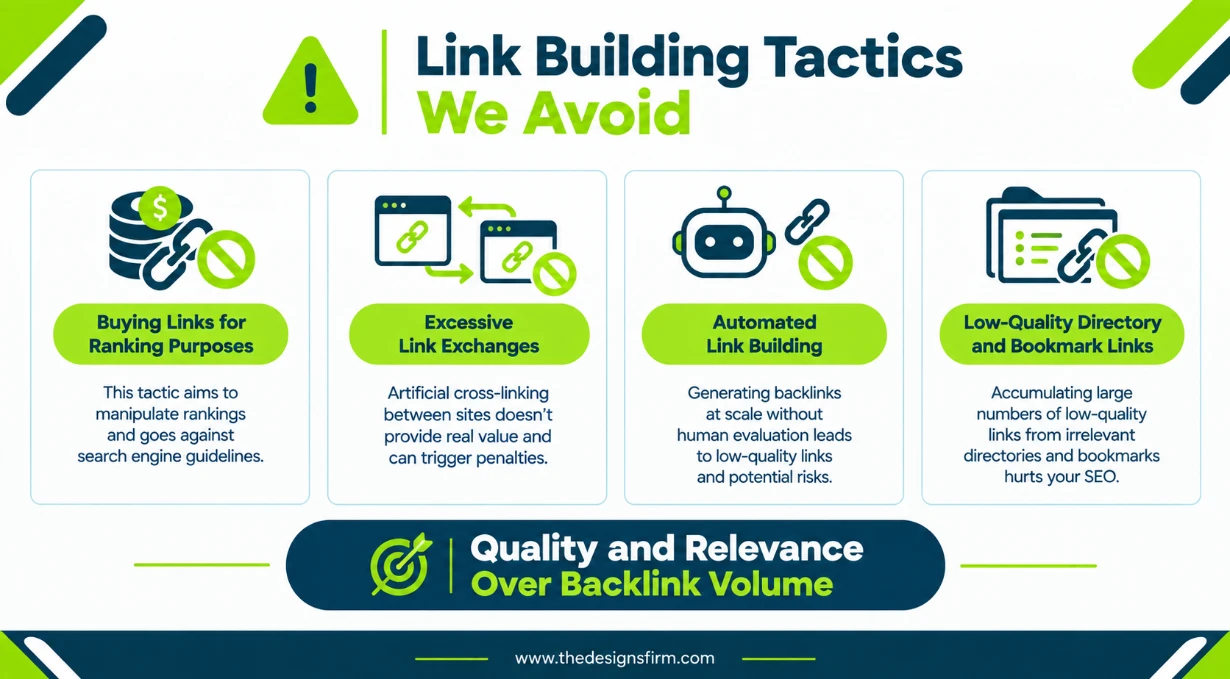
Some tactics can produce large numbers of backlinks but create little long-term value and may conflict with Google’s spam policies.
Buying Links for Ranking Purposes
Buying a link specifically to manipulate search rankings is different from paying for legitimate advertising.
Google’s spam policies identify buying or selling links for ranking purposes as link spam. Google also states that paid advertising links are acceptable when they are appropriately qualified with rel=”sponsored” or rel=”nofollow”.
Therefore, the intent and treatment of the link matter.
Excessive Link Exchanges
A simple:
“You link to us and we’ll link to you.”
arrangement is not a sustainable link-building strategy.
Google specifically identifies excessive link exchanges and pages created primarily for cross-linking as examples of link spam.
A legitimate business relationship may naturally result in links between two organizations. That is different from creating the relationship solely to manipulate rankings.
Automated Link Building
Automated systems that generate backlinks at scale are another tactic to avoid.
Quality link building requires evaluating:
- Relevance
- Context
- Editorial quality
- Website legitimacy
- Audience
- Business value
Automation can help with prospect discovery and monitoring, but it should not replace human evaluation.
Low-Quality Directory and Bookmark Links
Submitting a website to hundreds of low-quality directories or bookmark sites simply to accumulate backlinks provides little strategic value.
Directories can still make sense when they are legitimate, relevant, and useful to users.
While many businesses search for cost-effective SEO strategies, the problem is treating directory submission as a volume-based backlink tactic rather than focusing on quality.
How We Measure Link Building Success
Backlink count alone does not tell us whether a campaign is working.
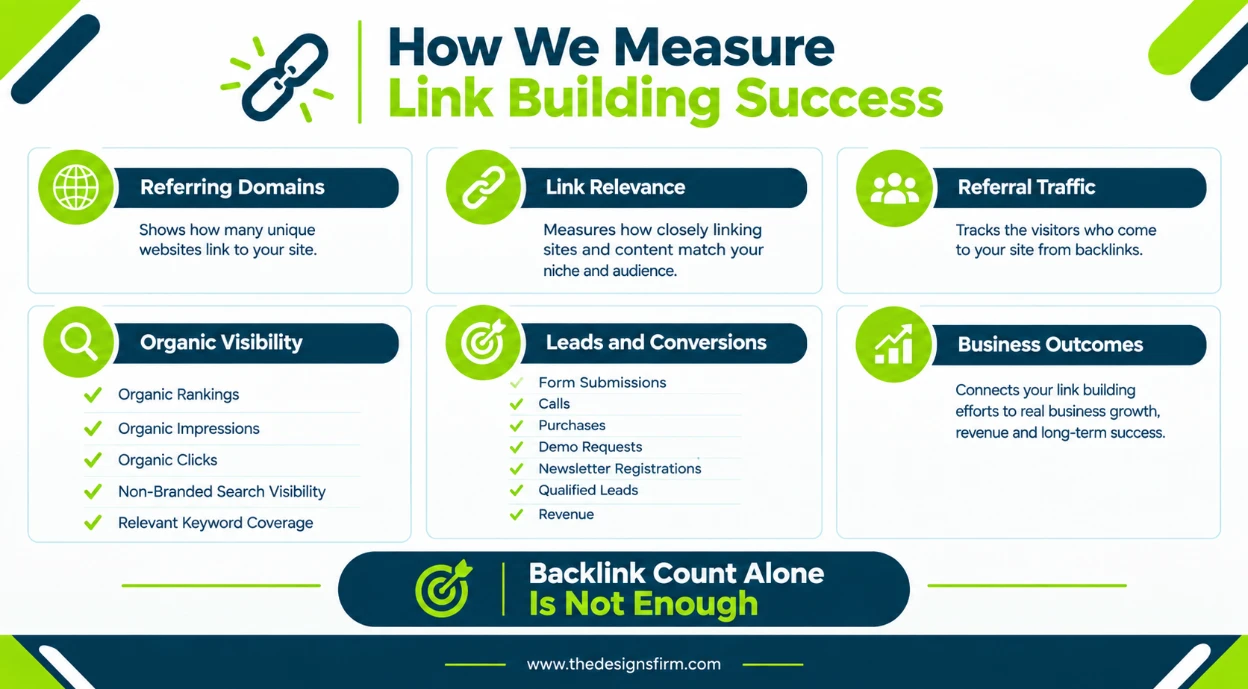
We evaluate link-building campaigns using multiple signals.
Referring Domains
A referring domain is a unique website that links to your website.
For example, five backlinks from one website still represent one referring domain.
Ahrefs research on referring domains vs backlinks has found a positive correlation between the number of unique referring domains and search traffic, although this should not be interpreted as proof of causation.
Link Relevance
We assess whether the linking website and page are relevant to the target business and content.
A highly relevant link can be more useful than several unrelated placements.
Referral Traffic
A backlink can have value even when it does not produce a noticeable SEO change.
If the link sends qualified visitors who engage with the website or become leads, it is contributing directly to business performance.
Organic Visibility
We also monitor whether target pages improve in:
- Organic rankings
- Organic impressions
- Organic clicks
- Non-branded search visibility
- Relevant keyword coverage
These metrics should be considered alongside other SEO activities rather than attributed entirely to link building.
Leads and Conversions
Ultimately, SEO exists to support business objectives.
Depending on the website, we may track:
- Form submissions
- Calls
- Purchases
- Demo requests
- Newsletter registrations
- Qualified leads
- Revenue
A backlink that contributes to meaningful business results can be more valuable than dozens of links that produce no relevant traffic or engagement.
How We Build a Sustainable Link-Building Strategy
At The Design Firm, we do not begin link building by collecting a list of websites and sending the same email to every prospect.
We start with the business and its SEO goals.
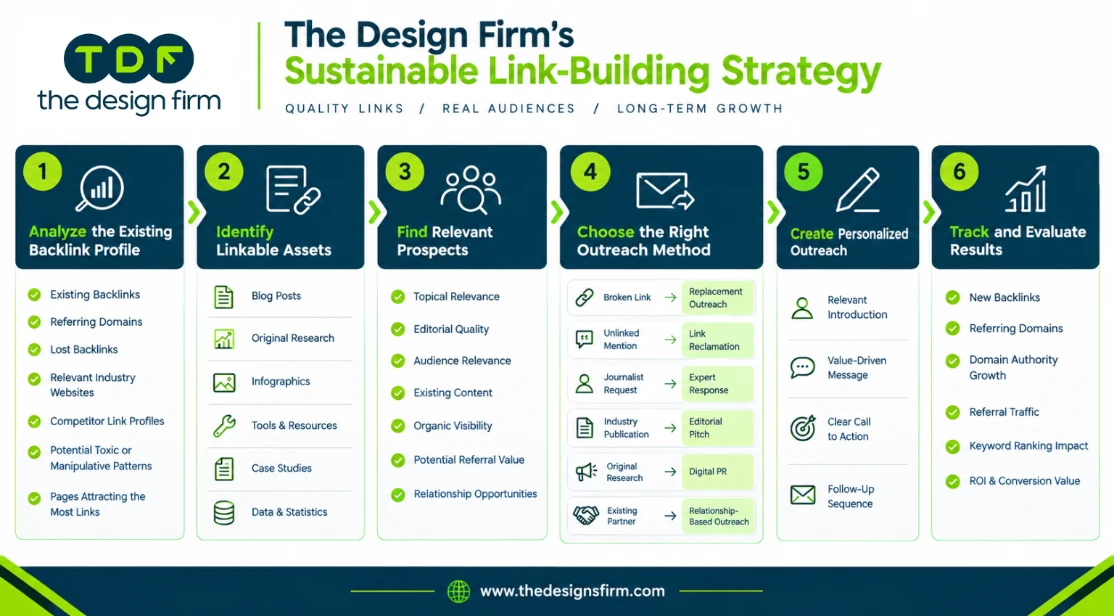
Step 1: Analyze the Existing Backlink Profile
We review:
- Existing backlinks
- Referring domains
- Lost backlinks
- Relevant industry websites
- Competitor link profiles
- Potential toxic or manipulative patterns
- Pages attracting the most links
Conducting a comprehensive SEO website audit gives us a robust starting point to analyze these factors.
Step 2: Identify Linkable Assets
Next, we determine which existing pages can naturally attract links.
If the website does not have strong linkable assets, we may recommend creating them.
Step 3: Find Relevant Prospects
We identify websites based on:
- Topical relevance
- Editorial quality
- Audience relevance
- Existing content
- Organic visibility
- Potential referral value
- Relationship opportunities
We do not use Domain Rating as the only qualification metric. Ahrefs itself recommends evaluating DR alongside other indicators such as traffic and URL-level metrics.
Step 4: Choose the Right Outreach Method
Different opportunities require different approaches.
For example:
- Broken link → Replacement outreach
- Unlinked mention → Link reclamation
- Journalist request → Expert response
- Industry publication → Editorial pitch
- Original research → Digital PR
- Existing partner → Relationship-based outreach
Using the same outreach template for every opportunity usually produces poor results.
Step 5: Create Personalized Outreach
A good outreach message should quickly explain:
- Why we are contacting the recipient
- What we found
- Why our resource is relevant
- How it can help their audience
Relying on professional copywriting services ensures we avoid exaggerated claims, generic compliments, and unnecessary paragraphs when crafting these emails.
Step 6: Track and Evaluate Results
We monitor:
- New referring domains
- Acquired backlinks
- Lost links
- Referral traffic
- Organic performance
- Outreach response rates
- Qualified opportunities
- Leads and conversions
Monitoring these metrics over time helps us continuously refine our link building strategies to determine which tactics are actually producing useful results.
Common Link Building Mistakes
Chasing Backlink Quantity
More backlinks do not automatically mean better SEO.
A campaign that produces hundreds of irrelevant links may be less useful than one that earns a smaller number of relevant editorial mentions.
Focusing Only on Domain Rating
DR is useful for analyzing backlink strength, but it is an Ahrefs metric—not a direct Google quality score.
A high DR does not automatically make a website a good link prospect.
Using Exact-Match Anchor Text Everywhere
Natural links use varied anchor text.
Forcing the same commercial keyword into every backlink can make a link profile look unnatural and may turn otherwise legitimate outreach into a manipulation-focused strategy.
Sending the Same Outreach Email to Everyone
Publishers can quickly recognize mass-produced outreach.
Personalize the reason for contacting them and make the request relevant to their specific page.
Ignoring the Page That Receives the Link
Getting a backlink to a weak or irrelevant page is not necessarily useful.
Thorough on-page SEO optimization is critical to the process. Before outreach, make sure the target page:
- Satisfies search intent
- Provides genuine value
- Is internally linked
- Is technically accessible
- Supports the business objective
- Gives the referring audience a useful destination
Measuring Only Rankings
Rankings matter, but they are not the only outcome.
A successful link-building campaign can also generate referral traffic, brand exposure, relationships, media coverage, and qualified leads.
Final Thoughts
Modern link building is not about finding the fastest way to generate backlinks. It is about creating enough value that another website has a genuine reason to reference your business or content.
We recommend combining content creation, strategic guest contributions, HARO and other digital PR opportunities, broken-link outreach, link reclamation, resource-page outreach, partnerships, original research, and relationship building rather than relying on one tactic.
The most important question is simple:
Would this link make sense if search engines did not exist?
If the answer is yes because the link helps readers discover something genuinely useful, you are much closer to building a sustainable link profile.
If the answer is no because the only reason for the link is to manipulate rankings, reconsider the tactic.
That shift—from building links to earning legitimate references—is what makes link building a sustainable part of modern SEO.