
11 Best Free Email Marketing Tools for Small Businesses
Free email marketing tools give small businesses a practical way to build an audience, send campaigns, and measure engagement without committing to a monthly subscription. The right platform depends on your list size, sending volume, automation needs, and existing software stack. Some free plans are generous enough for ongoing marketing, while others are mainly useful for testing a platform. In this guide, we compare 11 popular options using their current free-plan limits and features so you can choose a tool that fits your business today and can scale with you.
Key Takeaways
- Free email marketing plans vary significantly in subscriber and monthly sending limits.
- Sender, Kit, EmailOctopus, Brevo, and Zoho Campaigns currently offer particularly substantial free-plan allowances, although their features and restrictions differ.
- Mailchimp and MailerLite have reduced their free-plan audience limits, so older comparisons of these platforms may no longer be accurate.
- A free plan should be evaluated by more than subscriber count. Sending limits, automation, forms, integrations, branding, and reporting can affect its usefulness.
- Your email platform should support your growth strategy rather than force you to migrate as soon as your list starts growing.
Table of Contents
Why Email Marketing Still Matters for Small Businesses
Email remains an important marketing channel because it gives businesses a direct way to communicate with people who have voluntarily joined their audience.
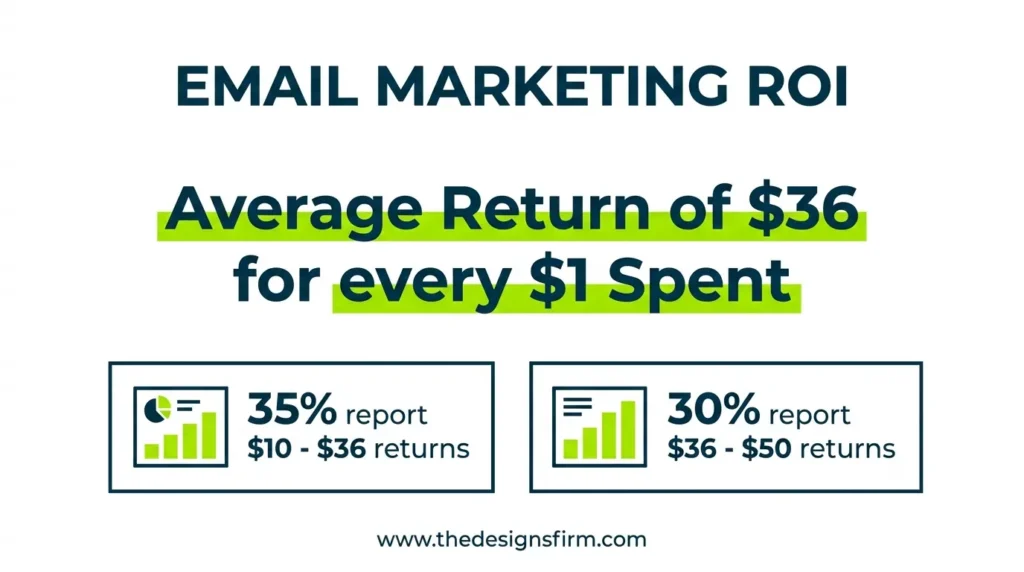
The financial case can also be strong. Litmus reports that email generates an average return of $36 for every $1 spent, although actual returns vary considerably by company, industry, strategy, and measurement approach.
More recent Litmus research found that 35% of companies reported returns between $10 and $36 for every $1 spent on email marketing, while another 30% reported returns between $36 and $50.
That does not mean every small business will achieve those results. Your return depends on factors such as list quality, offer, segmentation, copy, frequency, deliverability, and conversion experience.
At The Design Firm, we treat email as part of a broader digital marketing system rather than an isolated channel. Understanding how to find your target audience ensures your website captures the right leads, while email nurtures the relationship, and your conversion process turns that attention into business.
What to Look For in a Free Email Marketing Tool
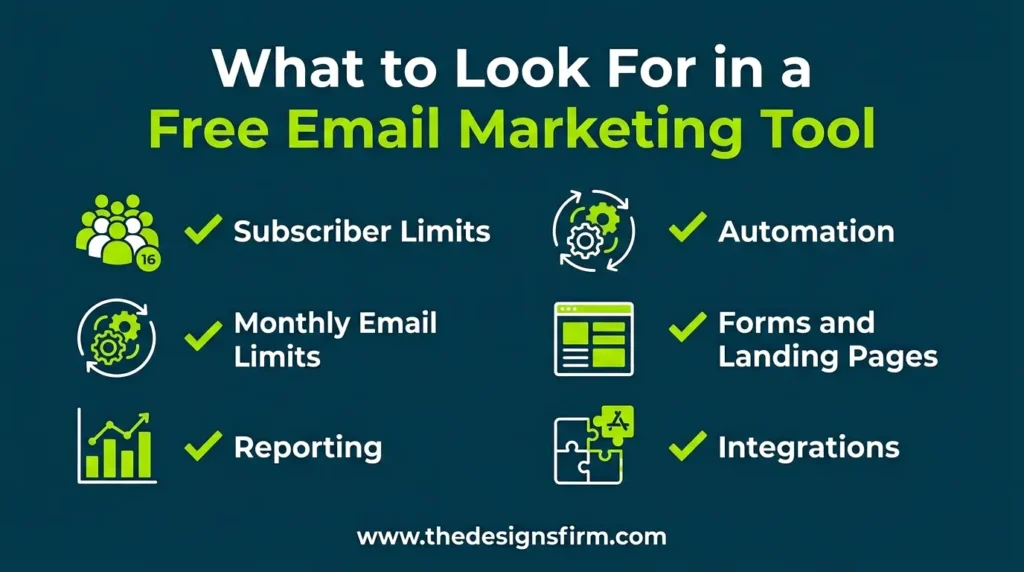
A free plan can look impressive until you discover that an important feature is locked behind a paid subscription. Before choosing a platform, evaluate these areas.
Subscriber Limits
Check how many contacts or subscribers you can store.
A 250-contact limit may be sufficient for a new local business, but it can become restrictive quickly if you are actively generating leads. Other platforms allow thousands of subscribers on their free plans.
Do not confuse the number of contacts you can store with the number of people you can email. Some platforms use separate limits for contacts and monthly sends.
Monthly Email Limits
A platform may allow thousands of subscribers but restrict how many emails you can send each month.
For example, Brevo’s free plan permits up to 100,000 stored contacts but limits sending to 300 emails per day. That makes its free plan structurally different from a platform offering 10,000 monthly sends.
Automation
Marketing automation lets you trigger emails based on subscriber actions.
Useful examples include:
- Welcome emails
- Lead-nurturing sequences
- Abandoned-cart emails
- Product follow-ups
- Course or content sequences
- Re-engagement campaigns
If automation is central to your strategy, check whether it is actually included in the free plan rather than merely available during a trial.
Forms and Landing Pages
Growing your list requires more than sending emails. Look for signup forms, landing pages, pop-ups, and integrations that help you capture subscribers.
Reporting
At minimum, you should be able to monitor campaign engagement and identify which emails are generating results.
Integrations
Your email platform should work smoothly with the tools you already use, such as your custom website, CRM, e-commerce platform, forms, analytics system, or automation software.
The 11 Best Free Email Marketing Tools for Small Businesses
There is no single platform that fits every small business. The following options differ significantly in audience limits, sending allowances, automation, and positioning.
1. Mailchimp
Mailchimp remains a recognizable option for businesses that want a straightforward way to start email marketing.
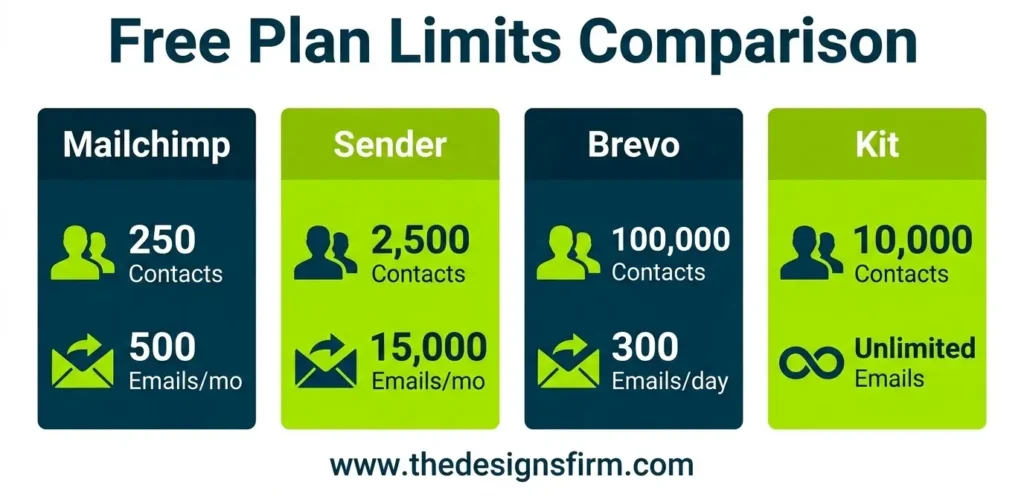
However, its current free plan is much smaller than the allowance described in many older articles. Mailchimp’s free plan supports up to 250 contacts and 500 email sends per month, with a daily sending limit of 250. It includes one audience and one user.
That makes Mailchimp most relevant to businesses with a very small starting list.
Free-plan limits:
- Up to 250 contacts
- 500 email sends per month
- 250 sends per day
- One audience
- One user
Best suited for: Very small businesses that want a familiar email marketing platform and are starting with a small subscriber base.
Important consideration: Many older articles still quote Mailchimp’s previous free-plan limits. Check the current plan before publishing or relying on outdated comparisons.
2. HubSpot Email Marketing
HubSpot combines email marketing with its CRM, making it useful for businesses that want customer data and marketing activity in one ecosystem.
Its free marketing tools currently include 2,000 email sends per calendar month. HubSpot also allows non-marketing contacts to be stored in its CRM without using them for marketing emails.
This distinction matters because the CRM contact limit and marketing-email contact allowance are not the same thing.
Free-plan email allowance:
- 2,000 marketing email sends per calendar month
- CRM functionality
- Marketing tools with HubSpot branding
Best suited for: Small businesses that want their email marketing connected closely to a CRM.
Important consideration: Businesses should examine HubSpot’s marketing-contact rules carefully before building a large database.
3. Sender
Sender offers one of the larger free allowances among dedicated email marketing platforms.
Its Free Forever plan currently supports 2,500 subscribers and up to 15,000 emails per month. It also includes automation, segmentation, forms, pop-ups, templates, and landing pages.
That combination makes Sender a standout among digital marketing tools for small businesses that need more room to grow without immediately paying for advanced functionality.
Free-plan limits:
- Up to 2,500 subscribers
- Up to 15,000 emails per month
- Unlimited automation and segmentation
- Forms and pop-ups
- Email templates
Best suited for: Small businesses that need a relatively high sending allowance and want automation without immediately moving to a paid plan.
4. MailerLite
MailerLite has changed its free plan significantly in 2026.
The current Free plan supports up to 250 subscribers and 2,500 monthly emails. It includes campaigns, three automations, one website, one landing page, and three signup forms.
This is substantially different from older versions of the plan that allowed 500 subscribers and 12,000 monthly emails. MailerLite confirmed the change in June 2026.
Free-plan limits:
- Up to 250 subscribers
- 2,500 emails per month
- Three automations
- One website
- One landing page
- Three signup forms
- Two user seats
Best suited for: New businesses that value a simple interface, visual email creation, and basic automation.
5. Brevo
Brevo takes a different approach to free-plan limits.
Instead of restricting the number of contacts you can store, its free plan allows up to 100,000 contacts. The major restriction is sending volume: you can send up to 300 emails per day.
That means Brevo can be useful for businesses with a large database that sends relatively small campaigns.
Free-plan limits:
- Up to 100,000 contacts
- 300 email sends per day
- Email and SMS campaigns
- Transactional email and SMS
- Drag-and-drop editor
Best suited for: Businesses that need to store a large contact database but have modest daily email volume.
Important consideration: A large contact allowance does not mean you can send a large campaign to your entire list at once. The 300-per-day sending limit is the critical restriction.
6. Kit
Kit is designed primarily around creators, newsletters, and audience-building businesses.
Its free plan now supports up to 10,000 subscribers, with unlimited forms, landing pages, email broadcasts, audience tagging, segmentation, digital products, and subscriptions.
This is another platform where older articles are likely to be outdated. Previous comparisons often cite a 1,000-subscriber free plan, while Kit’s current free plan has expanded substantially.
Free-plan limits:
- Up to 10,000 subscribers
- Unlimited email broadcasts
- Unlimited forms
- Unlimited landing pages
- Audience tagging and segmentation
- Digital products and subscriptions
- A/B testing for broadcasts
Best suited for: Creators, bloggers, newsletter publishers, coaches, educators, and businesses built around an audience.
Important consideration: Visual automations and email sequences are among the features reserved for paid plans.
7. Moosend
Moosend is different from most platforms on this list because its current offering is centered around a 30-day free trial rather than a permanent free plan.
The trial does not require a credit card and provides access to core features such as the email builder, automation, segmentation, forms, and landing pages. Moosend states that the trial includes unlimited email sends for up to 1,000 contacts during the trial period.
Free access:
- 30-day free trial
- No credit card required
- Core email marketing features
- Automation
- Segmentation
- Landing pages and forms
- Unlimited email sends during the trial for up to 1,000 contacts
Best suited for: Businesses that want to test a more advanced email marketing platform before paying for a subscription.
Important consideration: Do not describe Moosend as a permanent free email marketing tool. Its current model is a free trial followed by paid plans.
8. EmailOctopus
EmailOctopus offers a straightforward free plan with a relatively high subscriber allowance.
The current Starter plan supports 2,500 subscribers and 10,000 emails per month. The free plan also includes landing pages, forms, automations, and the platform’s email builder, although some functionality is restricted compared with paid plans.
Free-plan limits:
- Up to 2,500 subscribers
- 10,000 emails per month
- One landing page
- One form
- Up to three automations
- One user
- 30-day report availability
Best suited for: Small businesses that want a relatively simple email platform with a substantial free sending allowance.
9. Mailjet
Mailjet provides both marketing and transactional email functionality, making it useful for businesses that need robust email infrastructure beyond newsletters, particularly for complex e-commerce website development projects.
Its current free plan includes 1,000 contacts and 6,000 emails per month, with a daily sending limit of 200 emails. It also includes an advanced email editor, basic statistics, form building, APIs, SMTP relay, and webhooks.
Free-plan limits:
- Up to 1,000 contacts
- 6,000 emails per month
- 200 emails per day
- Advanced email editor
- Basic statistics
- Form builder
- API and SMTP functionality
Best suited for: Businesses that need both marketing-email functionality and developer-oriented email infrastructure.
10. Zoho Campaigns
Zoho Campaigns is particularly relevant if your business already uses Zoho products.
Its Forever Free plan currently supports up to 2,000 contacts and 6,000 emails per month. It includes templates, a drag-and-drop editor, list management, integrations, and basic reporting.
Free-plan limits:
- Up to 2,000 contacts
- 6,000 emails per month
- Up to five users
- Drag-and-drop editor
- Templates
- Basic reporting
- Integrations
Best suited for: Small businesses already using Zoho CRM or other Zoho applications.
Important consideration: Several advanced capabilities, including automation and advanced segmentation, are restricted to paid plans.
11. Benchmark Email
Benchmark Email provides a free plan aimed at businesses that want to test its core email marketing capabilities.
Its January 2026 Free Starter Plan documentation states that users can upload up to 500 contacts and send up to 3,500 emails per month. It also includes Automation Lite, segmentation, email reports, signup forms, and a drag-and-drop editor.
Benchmark’s current pricing page confirms the 500-contact free tier, although its public pages have displayed different monthly send figures, so we recommend verifying the account-level allowance before publishing a comparison.
Free-plan limits:
- Up to 500 contacts
- Up to 3,500 monthly emails according to its January 2026 plan documentation
- Automation Lite
- Segmentation
- Signup forms
- Drag-and-drop editor
- Email reports
Best suited for: Small businesses that want basic email marketing and lightweight automation without a complex setup.
Free Plan vs. Free Trial: Know the Difference
One of the biggest mistakes when evaluating free email marketing tools is treating every free offer as the same.
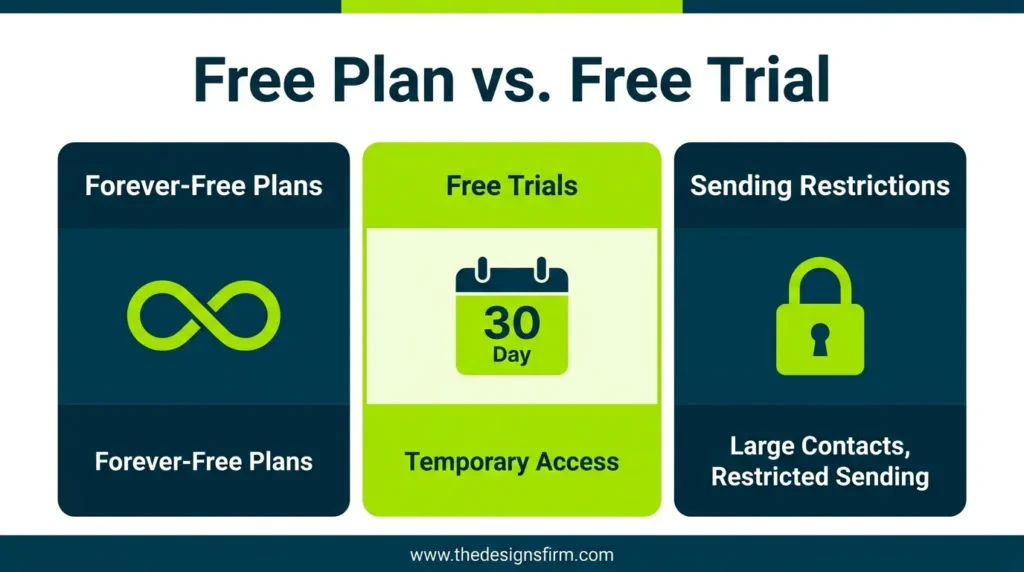
There are three common models:
Forever-Free Plans
These allow you to continue using the platform without paying, subject to its limits.
Examples include:
- Sender
- Kit
- EmailOctopus
- Brevo
- Zoho Campaigns
- Mailchimp
- MailerLite
The limitations vary significantly between them.
Free Trials
A free trial gives you temporary access to paid functionality.
Moosend currently offers a 30-day free trial rather than a permanent free plan.
Free Plans With Sending Restrictions
Some platforms allow a large number of stored contacts but restrict how many emails you can actually send.
Brevo is a good example: its free plan allows up to 100,000 contacts but limits sending to 300 emails per day.
Understanding these differences is more useful than simply counting how many contacts a platform allows.
How to Choose the Right Tool for Your Small Business
The right choice depends on your current marketing requirements.
If You Have a Very Small Email List
Mailchimp or MailerLite can provide the basic functionality needed to start, although both currently cap their free audiences at 250 contacts.
If You Need More Subscribers
Kit, Sender, EmailOctopus, and Zoho Campaigns provide considerably larger free audience allowances.
If You Have a Large Database
Brevo stands out because its free plan allows up to 100,000 stored contacts. The trade-off is its 300-email daily sending limit.
If You Need Automation
Sender and MailerLite include automation capabilities in their free offerings, while Kit reserves visual automations and email sequences for paid plans.
If You Already Use a CRM
HubSpot and Zoho Campaigns become more relevant when your email marketing needs to connect closely with your CRM and broader business systems.
If You Need Transactional or Developer Features
Mailjet provides APIs, SMTP relay, and webhooks on its free plan, making it worth considering when email is part of a broader infrastructure, such as integrating notifications directly from a custom WordPress website, rather than only a newsletter channel.
Do Not Confuse Email Marketing With Email Outreach
Email marketing and cold outreach are different activities.
An email marketing platform is generally designed for communicating with people who have voluntarily subscribed to receive your communications. This permission-based approach is a fundamental principle of inbound marketing, ensuring you only engage those who actually want to hear from you. Buying, scraping, or importing unrelated contact lists can create severe deliverability, compliance, and reputation problems.
Your growth strategy should focus on attracting relevant subscribers through legitimate channels such as:
- Website signup forms
- Lead magnets
- Product registrations
- Content downloads
- Event registrations
- E-commerce purchases
- Consultation requests
A smaller list of relevant, permission-based subscribers can be more useful than a much larger database of people who never asked to hear from you.
Keep Your Email List Clean
Choosing an email platform is only part of the job.
Over time, lists can accumulate invalid addresses, abandoned inboxes, duplicates, and subscribers who no longer engage. Poor list hygiene can reduce campaign performance and create unnecessary sending costs.
We recommend regularly reviewing:
- Hard bounces
- Unsubscribes
- Duplicate contacts
- Long-term inactive subscribers
- Engagement trends
- Spam complaints
Do not keep inactive contacts indefinitely simply because a platform allows you to store them. Maintaining a clean list protects your sender reputation and reinforces a strong brand strategy by ensuring your messages reach those who genuinely engage with your business.
Build Email Marketing Around Your Website
Your email platform should connect to your broader marketing system.
A practical small-business setup might look like this:
Website → Lead Capture → Email List → Segmentation → Automated Nurturing → Conversion
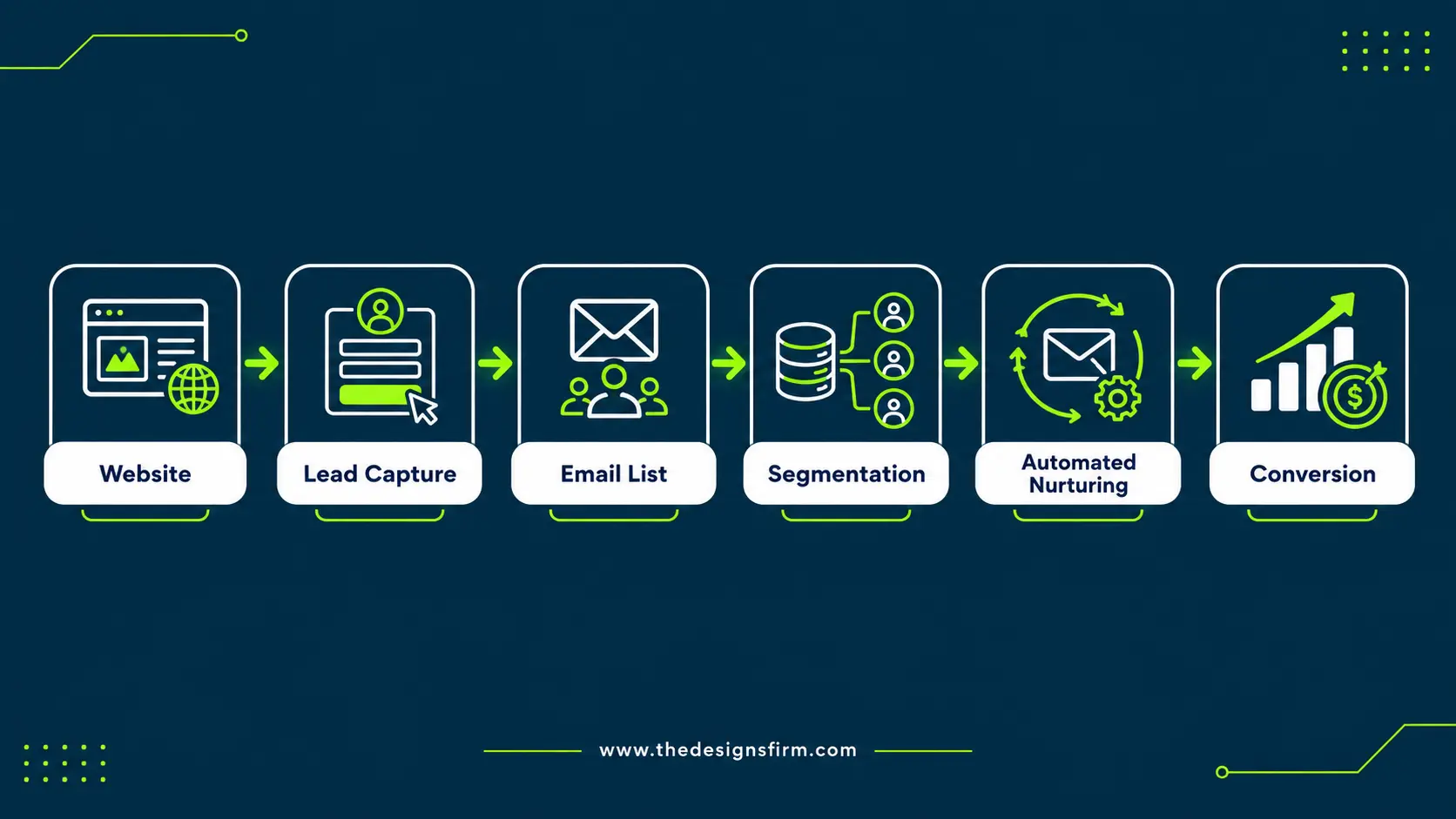
For example, someone may discover your business through optimized organic search results driven by professional SEO services, visit a service page, download a useful resource, join your email list, receive a welcome sequence, and eventually become a customer, thereby improving your overall conversion rate.
That is why email marketing should not operate independently from SEO, content marketing services, paid advertising, social media marketing, and conversion optimization.
As a leading provider of email marketing services, we approach this channel as part of the larger customer journey. We can help businesses plan campaigns, craft compelling messages using effective sales and marketing copywriting techniques, build templates, develop automated workflows, segment audiences, and connect email campaigns with broader digital marketing goals.
Common Mistakes Small Businesses Should Avoid
Choosing a Tool Based Only on the Contact Limit
A platform offering 10,000 subscribers is not automatically more useful than one offering 2,000. Sending limits and automation capabilities can completely change the practical value of a plan.
Ignoring Free-Plan Branding
Some free plans place the platform’s branding inside your emails. If professional brand presentation and logo design consistency are important to your company, check whether that third-party branding can be removed without upgrading.
Building a List Without a Conversion Strategy
More subscribers do not automatically mean more revenue.
Developing valuable content creation ideas gives you a clear reason for someone to subscribe and provides a relevant journey after they join.
Failing to Check Upgrade Costs
Your free plan may work today but become expensive when your list grows.
Before investing time in a platform, check the next pricing tier and determine whether it remains viable as your audience expands.
Relying on Outdated Comparisons
Email marketing platforms frequently change their pricing and feature limits.
For example, MailerLite changed its free plan in June 2026, while Kit’s current free plan now supports up to 10,000 subscribers.
Always verify current limits before making a platform decision.
How We Can Help With Your Email Marketing
A free platform gives you the infrastructure, but it does not create comprehensive online marketing strategies for you.
As a top-rated digital marketing agency, we offer comprehensive digital marketing packages that can help you develop a complete system around your audience and business objectives. We can work on campaign planning, email copy, branded templates, lead nurturing, segmentation, automation, and conversion-focused email strategies.
We can also connect email marketing with your broader SEO, content marketing, social media, Google Ads management, and website strategy.
The goal is not simply to send more emails. It is to build a system that turns relevant subscribers into qualified leads, customers, and repeat buyers.
Conclusion
Free email marketing tools have become powerful enough to support many small businesses without an immediate software budget. However, the best platform depends on your audience size, sending frequency, automation requirements, integrations, and long-term growth plans.
Before signing up, compare the actual free-plan limits rather than relying on old “best free email marketing tools” lists. A platform that fits your business today should also have a clear upgrade path when your audience grows.
Start with the tool that matches your current requirements, build a permission-based email list, measure campaign performance, and improve your strategy as you collect real customer data.